Change Language :
Flexible cables for moving applications
chainflex® cables for continuous motion
A flexible cable is designed to transmit power, data and signals in applications involving repeated movement. Their performance under dynamic conditions depends on factors such as conductor stranding, core insulation, cable lay-up and outer jacket material. These construction elements influence bending flexibility, torsional resistance, abrasion resistance, and service life.
chainflex® flexible cables from igus® are engineered for dynamic applications involving continuous bending, repeated acceleration and, depending on the application, torsional movement. They are used in energy chains, automation systems, machine tools and robotics, where reliable electrical transmission is essential.
Each chainflex® cable is developed and tested for its intended application, with cable designs validated through extensive laboratory testing and practical application experience. This helps establish predictable service life, improve operational reliability and reduce unplanned downtime.
Why choose chainflex® flexible cables?

Made for motion
Designed specifically for continuous movement in energy chains and other dynamic applications.

Wide range
Choose from control, motor, servo, data, bus, encoder, fibre optic, robot, hybrid and special cables.

Available harnessed
Pre-assembled cable solutions with compatible connectors for faster installation and reduced assembly time.

Up to 4-year guarantee
chainflex® cables can be guaranteed for up to four years or up to 12.5 million double strokes*.

Predictable service life
Every chainflex® cable is extensively tested to provide reliable service life predictions and reduce costly unplanned downtime.

Configurable
Find suitable cable types, compare technical properties and configure your unharnessed cable online.

Tech up, cost down
Different outer jacket materials provide a range of options, allowing you to balance technical performance with cost-effectiveness.

Available by the metre
All cable types are available in individual lengths, no cutting cost** and with UK stock supporting fast delivery.
Compare flexible cable types
Different moving applications require different electrical and mechanical properties.
| Cable type | Typical function | Typical moving application | What to consider |
|---|---|---|---|
| Control cables | Control and signal transmission | Energy chains, automation and machinery | Core configuration, bend radius, shielding and movement |
| Motor cables | Motor power supply | Dynamic drive applications | Voltage, conductor construction, bend radius and EMC requirements |
| Servo cables | Servo drive and motor connection | Servo axis and automated machinery | Drive-system compatibility, shielding and dynamic movement |
| Data & bus cables | Data and communication | Industrial networks and moving machine axes | Protocol, transmission requirements, shielding and bend radius |
| Encoder & measuring cables | Feedback and measurement | Motors, sensors and measuring systems | Signal integrity, shielding and continuous flexing |
| Fibre optic cables | High-speed data transmission | Industrial communication and moving systems | Fibre type, bend radius and movement conditions |
| Robot & torsion cables | Power, signal and data for multi-axis movement | Robots and multi-axis movement | Torsion, twist, bend radius and robot-specific movement |
| Hybrid & special cables | Combined or application-specific functions | Special machinery and demanding environments | Application conditions, media, temperature and mechanical load |
Browse cable types
Choose the cable category according to the electrical function, movement, environment and installation requirements of your application.


The chainflex® test laboratory
Testing is central to the chainflex® approach. igus tests cables under dynamic conditions to build application knowledge and support predictable service life.
5,500 m²
test laboratory area
64
test systems
800+
parallel tests
2 billion
annual test cycles
Applications with chainflex® cables


Cable tools & configurators
igus® offers a range of online tools to help users select the right cable for their application. By entering key application parameters, users can identify suitable products and calculate their expected service life. Final configurations can then be saved or added directly to the shopping cart for ordering.


Are your cables performing to their full lifecycle potential?
Learn how continuous flexing, torsion, and mechanical stress affect cable longevity, and how to optimise performance in demanding applications.
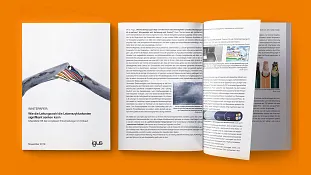
Explore more about chainflex® flex cables


Build your full cable management solution


Frequently asked questions regarding chainflex® flexible cable
A flexible cable is a type of electrical cable designed to be easily bent or twisted without damaging the internal wires. These cables are typically used in applications where frequent movement or bending is required. Alternatively, dynamic cables are specifically designed for continuous motion applications, where the cable must move back and forth millions of times without failures. igus® chainflex® cables are engineered to withstand constant bending, twisting, and movement without compromising performance or durability. They are made with high-quality materials and construction techniques to ensure reliable operation in challenging environments.
They are specifically designed for continuous movement and tested under dynamic conditions, with constructions selected around bend radius, movement, speed, acceleration and environmental requirements.
Cables by igus® are designed and produced specifically for continuous motion in dynamic applications. Unlike standard industrial cables, which are built primarily for static use, every chainflex® cable is carefully engineered from the inside out to deliver the best maximum durability and reliability. With igus® manufacturing our process includes:
- Optimised conductor design - stranded conductors are laid with a short pitch length to reduce internal stress and extend service life in motion.
- Specific core design - Depending on the core configuration, the cores are either layered, bundled or placed in twisted pairs around a centre element, ensuring stability and preventing corkscrewing or untwisting in an e-chain.
- High quality insulation and jacket materials - We only use tested, high performance insulation materials with different property variations, PVC, PUR, TPE and iguPUR are used, tailored to the environment. Things like oil-resistant, cold flexing, UV and temperature resistance.
- Pressure extruded inner and outer jackets - Unlike standard cables where the outer jacket is often loosely applied, our pressure extruded jackets bond tightly to the core bundle, preventing abrasion and increasing cable strength.
- Testing, testing, testing - Every chainflex® cable undergoes rigorous electrical, mechanical and quality checks before leaving production.
While standard control or power cables may look similar from the outside, they are generally not designed for movement. Their conductors, insulation and jacket are optimised for stationary use, which means they are placed in dynamic applications (such as energy chains) they quickly suffer from core breakage, corkscrewing, jacket rupturing or electrical failure.
Consider the electrical function, movement, bend radius, temperature, media exposure, shielding, travel, speed and installation conditions. The product finder and service-life calculator can help.
You can buy cables by the metre with igus®.
igus® manufacture and supply a variety of cable including, control, data, bus, motor, encoder, servo, robot, fibre optic, specialist designed cables. All of these cables can be ordered as a little as a metre. For custom cables there is an MOQ for production.
We have a large range of various cable types in stock in the UK so we try and ship out within 24 hours. If we don't have the cable in the UK and are unable to offer a suitable alternative, we can get them in from Germany in approximately 8 working days
- Yes, all 6,000+ catalogue cables are designed for continuous use in e-chains®.
- However, our CF800 series is widely used for fixed installations thanks to its excellent price-performance ratio.
- You can even use one cable type for both fixed and moving applications, with a 4-year guarantee.
- This reduces costs for purchasing, stock management, and inspections.
- We deliver 16,000 cables weekly worldwide without issues.
- We use the same connector manufacturers as Siemens (Intercontec).
- The only difference is the cable itself. OEM warranties cover the unit, not external cables.
- With igus® readycables, you get a guarantee on both your motor and dynamic cables.
PVC
PVC, or polyvinyl chloride, is a very versatile thermoplastic material. Because of its chemical structure and low flammability, it is often used on production and assembly lines. But it is also used frequently in packaging and stage lighting.
PUR
PUR, or polyurethane, is a halogen-free, self-extinguishing thermoplastic elastomer. This jacket material has become increasingly important for cables in recent years. PUR's advantages are notch strength and cold flexibility. PUR also has better chemical compatibility than other materials.
TPE
TPE stands for thermoplastic elastomers and is the generic term for numerous subcategories. TPE materials are predominantly used for high-quality, flexible cables. The reason for this is that they withstand mechanical loads very well and are highly resistant to external influences such as chemicals or temperatures.
We recommend depending on the type of cable, different sizes of space reserves must be used. In the following table you can read the recommended % values.
Space reserves in % for various cables
Cable: clearance space "all round"
Electrical round cable: 10 %
Electrical flat cable: 10 %
Pneumatics: 5-10 %
Hydraulics: 20 %
Media hoses: 15-20 %
Overfilled e-chains often begin as a result of defective cables not being replaced, by simply being supplemented by another cable.
Hanging applications are generally possible, with the energy chain moving vertically up and down in a U-shape. We can realise installation heights of up to approximately 100 m. The correct distribution of the cable in the e-chain® and the feed-through of a perfect strain relief are decisive for the cable installation.
The tensile strength is defined by the conductor nominal cross section of the main cores. According to the standard, a cable in a suspended application may be loaded with 15 N/mm² copper of the main conductors or the cable requires a special supporting element.
EMC stands for electromagnetic compatibility and describes the fact that different devices do not influence each other. To ensure this protection, a cable must be electrically shielded. This protective effect is expressed strongly by the indication of the so-called optical coverage of the shield. This is the area of the cable that is optically covered by the shield.
HAR mainly describes cables for fixed or "flexible" installations. It's not just about the material. The HAR code describes: Cable type, nominal voltage, insulation material, outer sheath material, special specification of the cable, conductor type, number of conductors, conductor cross-section, etc.
Every cable manufacturer can orientate themselves on these standards and build cables according to these standards. With the materials of the harmonised standard it is not possible to build a cable that meets our requirements in terms of quality and service life.
A cable company specialises in a variety of cables for different applications. igus supply a wide range of cables designed for dynamic applications and various industries, as well as technical support, customisation options, and free online tools to help customers select the right cable for their specific needs. igus focuses on delivering high-quality, durable cables that meet the demands of dynamic motion and harsh environments, ensuring reliable performance for their customers.
Not every cable is suitable for any transmission length. With an electrical conductor, we are always limited in the transmission length, as the cable has losses over the long distance. In this case, the alternative to transmitting the Profinet signal on a long travel is a chainflex® fibre optic cable. With an optical fibre, you can also transmit a signal over long distances. This is due to the significantly lower attenuation values compared to a copper cable.
Underwriters Laboratories (UL for short) is an independent organisation that tests and certifies products with regard to their safety. UL develops standards and procedures for safety testing of products, materials, components, parts, appliances, systems and equipment.
More information about our UL certificationsDuring cable manufacturing, small gaps naturally form between the individual cores and bundles because the conductors are round and cannot fit perfectly together. These spaces, known as gussets, create hollow "valleys" within the cable structure. A gusset-filled extruded cable has these gaps filled with jacket material during production, resulting in a more stable construction with improved resistance to movement, deformation and wear.
The voltage class is directly related to the intended use of the cable or pipe. with the voltages transferred via these cables. For example, these are lower for control cable than for motor cable, as a small amount of power has to be transmitted.
A hybrid cable is commonly used in servo drive systems, combining power and data transmission within a single cable. It supplies power to the servo motor while simultaneously carrying feedback and control signals between the motor and the control system. By integrating multiple functions into one cable, hybrid cables can simplify installation, reduce cable requirements and save space.
More about our hybrid cablesEligible cables can be covered by a guarantee of up to four years or the applicable guaranteed number of double strokes, subject to the defined operating conditions.
Learn more about our 4-year guaranteeCFRIP® is an integrated zip-thread feature that allows the jacket of applicable chainflex® cables to be opened without additional stripping tools, helping reduce preparation time.
Additional resources


*Service life depends on operating conditions. Higher numbers of double strokes may be achievable. See chainflex® guarantee conditions and service life calculator.
**No cutting charges (up to 10 cuts of the same cable type and length). Subject to igus' discretion.
Contact us
Contact details

Opening hours
Office hours
Monday to Friday from 8 am - 8 pm.
Live chat:
24h