Change Language :
Energy chains
Reduce downtime & increase service life of cables with e-chain®
Cable management protects and guides dynamic cables in modern machinery using the right energy chain for the application. Effective cable management helps protect moving cables from wear, damage, and harsh operating environments, improving reliability and service life.
igus® plastic energy chains protect and guide cables and hoses, ensuring smooth transfer of power, data, and fluids - even in harsh environments. With over 40+ years of experience across industries like robotics, machine tools, and heavy equipment, our chains combine lightweight design with exceptional strength for millions of cycles.
At our 3,800 m² test lab, we run 10 billion test cycles annually on 180 stations, simulating speeds up to 8 m/s, travel lengths up to 240 m, and temperatures down to –40 °C. This rigorous testing backs our 4-year guarantee on chains and cables.
We deliver complete systems — chains, cables, separators, strain relief, and guide troughs - plus readychain and readycable assemblies cutting installation time by up to 95%.
10 tips for unsupported energy chain movement
Looking to maximise the service life and reliability of your energy chain system? This whitepaper shares 10 tips to help you design and optimise unsupported energy chain applications for improved performance, reduced downtime, and a better return on investment. Whether you're specifying a new system or improving an existing installation, these insights can help you avoid common pitfalls and keep cables and hoses moving safely and efficiently.
Browse energy chain systems


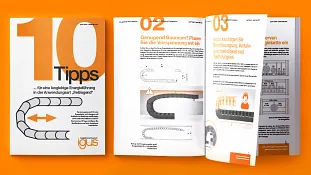
10 tips for a maintenance-friendly energy chain
Discover 10 practical engineering tips to optimise energy chain performance, minimise wear, and reduce maintenance requirements in dynamic applications. This technical guide highlights key design considerations that can help improve system uptime, extend service life, and lower lifecycle costs.

How to specify an energy chain?


Frequently asked questions regarding energy chains
Energy chains are used to guide moving power, data, fibre-optic, pneumatic and hydraulic services while helping protect them from excessive bending and abrasion.
Consider the services being carried, travel, speed, acceleration, installation orientation, environment, weight, fill level and required service life.
Yes. Energy chains can be configured with combinations of cables and hoses, with internal separation used where required.
Energy chains maintain the minimum bend radius required for the cables and hoses they protect while providing robust physical shielding. A key advantage is their ability to route multiple services side‑by‑side within a single system, for example, hydraulics, power cables, data lines, fibre optics, and fluid hoses. This makes them highly flexible and versatile, and it also allows for easy, cost‑effective cable upgrades throughout the system’s life cycle.
Because energy chains are passive components, moved simply by the machine’s motion, they require no additional power or drive mechanism. Manufactured from low‑friction, corrosion‑resistant plastics, they offer long service life with minimal maintenance.
The number of cables that can be integrated into an energy chain is virtually unlimited. With our full range of internal separation options, cables and hoses can be organised safely and configured to almost any required layout. One of the major advantages of energy chains is their ability to carry almost any combination of services within a single system — whether power, data, fibre optics, hydraulics, or fluids. This level of flexibility is not achievable with alternative solutions such as busbars or festoons.
A drag chain (also called an energy chain or e-chain®) guides and protects cables and hoses that move in dynamic applications. They go by a lot of names: cable carrier, cat track, drag chain, cable track and power-chain.
At igus, e‑chains are designed to:
- Prevent cable wear and failures
- Ensure safe cable movement at high speeds and long travels
- Reduce downtime by keeping the cable bend radius controlled
- Handle demanding environments such as machine tools, cranes, automation and robotics.
igus drag chains are manufactured from high-performance plastics, making the energy chains strong, robust and able to withstand a variety of environments. They are engineered for quiet operation, long service life, and maintenance‑free performance.
To correctly size an igus energy chain, measure:
- Inner Height (Hi)
- Inner Width (Bi)
- Bend Radius (R)
- Choose a radius at least 10–15x the cable diameter (or follow cable manufacturer specs). igus offers standard bend radii for every series.
- Travel Length
- Short travel = simple back‑and‑forth
- Long travel = may require a gliding energy chain on a guide trough
Tip: igus offers a free online e-chain configurator for automatic measurements and recommendations.
Almost every industry with moving energy requires energy chains: cranes, lifts, theatres, vessels, machine tools, renewable energy systems, electronics, pick-and-place machines, telescopes, agriculture, printing, vehicle sliding doors, and so on – the list is endless.
Use these core selection criteria:
- Travel length (short, long, robotic, vertical, side-mounted)
- Cable/hose type and quantity
- Speed and acceleration
- Environmental conditions
- Dirt, chips, dust
- Chemicals
- Outdoor weather
- Weight and fill level
- Required noise reduction
- Need for open or fully enclosed chain
Best tool: Use the igus e-chain® configurator, which recommends the correct series based on your inputs and provides a full BOM, CAD models, and expected service life.
igus offers multiple opening styles depending on the series:
- Crossbars open on one side
- Crossbars open on both sides
- Fully enclosed R-series (with removable lids)
To open most igus e-chains:
- Use a flat screwdriver or simply pull the crossbar upward depending on the version.
- The crossbar pops open for cable insertion.
- Snap it back into place — no tools typically required.
igus e-chains are designed for quick assembly without damaging cables.
Most igus energy chains are made from high-performance, tribology-optimised polymers that are:
- Lightweight
- Corrosion‑free
- Wear‑resistant
- Suitable for long service life without lubrication
For heavy-duty or extreme environments, igus also offers hybrid energy chains that combine:
- Plastic chain links, and
- Steel or stainless-steel components for extra strength
This gives the benefits of plastic (low weight, quiet operation) with the durability of metal.
You can find all energy chains made of conductive ESD material here.
Open energy chains
- Have removable crossbars
- Easy to access cables for installation or replacement
- Suitable for general-purpose indoor applications
Closed (fully enclosed) energy chains
- Sealed from dust, chips, debris and moisture
- Ideal for harsh environments: woodworking, machining, outdoor use
- Protect cables completely from contamination
Installation Tips
- Lay cables properly with sufficient clearance and follow the recommended bend radius.
- Use separators to create proper cable organisation inside the chain.
- Avoid cable tension — cables should move freely inside the e-chain.
- For long travels, ensure the chain is installed on an igus guide trough for smooth gliding.
- Ensure fixed and moving ends are mounted securely.
Maintenance
- igus e‑chains® are designed to be maintenance‑free, but best practice includes:
- Check cables periodically for wear
- Remove dirt or debris (especially in open chains)
- Inspect strain relief at the fixed end
- Ensure the chain moves freely without obstruction
- igus polymer chains require no lubrication and have long tested service life.
Or, explore igus® ready-to-install cable carrier systems, designed as fully assembled, plug-and-play solutions customised to your exact requirements. These systems streamline installation, cut costs, and minimise downtime. We also offer professional installation services to ensure your systems is set up perfectly and performs longer without interruptions.
igus® also offers a wide range of dynamically rated cables for use in constantly flexing applications (“chainflex®“), which are guaranteed for 10 million movements or up to 4 years when used as per our guidelines. These can be supplied with or without or with connectors and pre-fitted into the energy chains. We also offer steel and aluminium guide troughs for longer travels cable clamping solutions for cable strain-relief and chain interior separation options to ensure a long cable life inside the chain. We also offer design and project support, onsite services such as supervision and inspection and full turnkey installation.
igus® e-chains®, or energy chains, can cope with fill weights of up to 600 kg/m unsupported.
Find out more about igus® components for the offshore industry here.
igus® has thousands of energy chains on existing applications offshore including cantilever skids, pipelay towers, gantry cranes, and many more as seen here. Our polymer energy chains are maintenance-free, corrosion resistant, can cope with fill weights of up to 600 kg/m unsupported, and are cost-effective vs equivalent steel chains.
Find out more about igus® components for the offshore industry here.
All igus® energy chain sensors (push/pull monitoring, abrasion, motion, wear measurement, break detection) can be connected to an icom or icom. plus module. The module can transmit the measurement data to an equipment monitor or a computer, where they are displayed individually or in a dashboard.
You can discover the service life of igus® energy chains using the service life calculator.
Yes. We recommend the TH3 energy chain, which has been developed specifically for the food and beverage industry.
Yes, the autoglide system allows travels of up to 80 m without guide troughs.
As a rule, the standard temperature range for plastic energy chains is -40 °C to +130 °C, short term +170 °C.
Yes, plastic energy chains that use the igumid HT material can resist swarf as hot as + 850 C.
A detailed list provides information on the resistance of igus’s igumid G, TE, and NB materials to many chemical substances.
Although igus® does not manufacture hydraulic hoses, the hoses can be sourced and installed within your e-chain® to your requirements.
Our online tool prevents our customers from over filling the e-chains®. We have recommendations for the amount of clearance each service should have when installed within the e-chain® (relative to its OD); 10% for all round and flat cables, 5-10% for pneumatics, 20% for hydraulic hoses and 15-20% for all other media hoses.
Recommended for you


Contact us
Contact details

Justin Leonard01604 677240Contact us
Opening hours
Office hours
Monday to Friday from 8 am - 8 pm.
Live chat:
24h