Change Language :
Lead screw and lead screw nuts
How to select the right lead screw
What is a lead screw? Lead screws are cylindrical metal rods which have a continuous external thread along part or all of its length. Lead screws are also commonly known as threaded rod and threaded bar and these components can be used for fastening, fixing, and adjustment. With a variety of thread geometries, lead screws create a conversion from rotary motion into linear movement. There are a range of different thread profiles, pitches, diameters and materials. This allows customers to specify the correct lead screw for their application, depending on whether it is being used for fastening or mechanical motion.
Lead screws are used for a variety of applications, from medical and 3D printing, to robotics and packaging, the range of materials for lead screws and compatible nuts ensure we can accommodate all applications.
Types of lead screws and features
| Type of lead screw | Feature 1 | Feature 2 | Feature 3 |
|---|---|---|---|
| High helix | High speed | Large lead | Efficient movement and ideal for quick linear adjustments |
| Trapezoidal | High axial loads | Self-locking option | Ideal for positioning and lifting applications |
| Metric | Standard metric connection | Ideal for fastening applications | Standard and find threads available. |
Lead screw and lead screw nut products
dryspin® lead screw assemblies are engineered for precision linear motion applications requiring lubrication-free and maintenance-free operation. By combining optimised spindle geometries with tribologically enhanced polymer nuts, the system achieves efficiencies of up to 82% and delivers a service life approximately 30% longer than conventional lead screws.


invert_colors_off
100% maintenance-free, dry operation
content_cut
No cutting costs
shopping_cart
Shipping from 24 hours
published_with_changes
Quiet operation

Tools & configurators, information and support
igus® offers a range of online tools to help users find the right lead screw system for their application requirements. These tools indicate suitable products based on entered parameters, calculate expected service life, and provide 2D and 3D CAD models . Final configurations can be saved or sent to the shopping cart to be ordered.


What is the difference between a lead screw and ball screw?
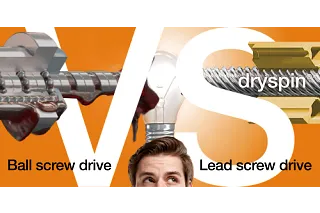
Lead screws and ball screw drives both convert rotary motion into linear movement. Despite this similarity, they work in fundamentally different ways and are therefore more suited to different applications.
One of the key differences is that a lead screw uses sliding motion between the screw and nut, whereas a ball screw uses recirculating balls. The main function of a ball screw is to reduce friction between the nut and lead screw, meaning they have the ability to achieve higher efficiency, speed as well as positioning accuracy.
When looking at lead screws, this type of spindle can offer advantages of low maintenance, quiet operation and cost-effectiveness. One main advantage of lead screws when comparing to ball screws is, depending on the thread geometry, lead screws can offer self-locking options. This is massively beneficial for applications where vertical movements are required, such as lifting applications.
Deciding between the two when designing an application there are factors that need to be considered such as load, speed, positioning accuracy, duty cycle, lubrication requirements, noise and maintenance.
Applications and customer examples of lead screws in use.


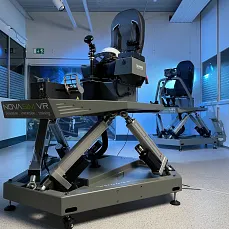
"The use of dryspin thread technology has significantly improved the entire behaviour of the drive, from the feel and sound volume to the extremely clean and quiet running behaviour."
Thomas Brunner
Head of Mechanical Engineering BRUNNER Elektronik
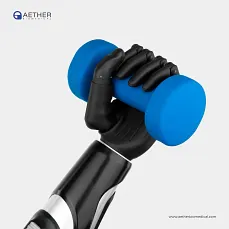
"We have not considered alternative bearing products. There was direct co-operation with representatives from igus. It worked very well and we are very satisfied with the form of co-operation and its results."
Marta Szymanowska
COO Aether Biomedical
Frequently asked questions
A lead screw is a threaded shaft that converts rotary motion into linear motion, commonly used in linear actuators, CNC machines, and presses.
The main types are; acme, trapezoidal. high helix, and ball screws.
Many lead screws do require lubrication, however igus® lead screws do not. We have matching nuts that are made from self-lubricating polymers so no additional lubrication is required.
The main materials that we offer are stainless steel, aluminium and steel.
Self-locking means that the nuts and screws cannot move without the application of an external force. It depends on the pitch and the friction coefficient.
In addition to proper material selection, using a preload mechanism is an effective way to reduce unwanted backlash. Three preload versions are available for our dryspin® high helix and trapezoidal threads: zero-backlash, low-backlash, and AB.
Theoretically, yes. It's important to consider the application parameters (axial load, rotational speed, etc.) and achieve the required positioning accuracy. Our expert system for screw drives offers optimal support in selecting the most suitable screw drive system for each application.
Depending on the system, trapezoidal screw noise can occur if the diameter, speed, and stroke exceed the recommended limits. This causes vibration or poor thread engagement, generating noise. Insufficient lubrication, misalignment, or the choice of nut and screw materials can also contribute. To reduce noise, optimise screw dimensions, ensure proper alignment, and use materials that minimise friction and wear.
Backlash is a purpose built gap between the mating threads of the lead screw and the accompanying nut. This allows a smoother movement without getting stuck or increasing friction. We have a range of pre-loaded nuts, as well as anti-backlash and zero-backlash variants.
The difference with right hand and left hand lead screws is the direction of the thread. There are also reverse lead screws which are both left and right hand and are blended in the middle of the spindle.
Contact us
Contact details

Opening hours
Office hours
Monday to Friday from 8 am - 8 pm.
Live chat:
24h