Change Language :
3D printing materials
Wear-resistant 3D filaments, powders, and resins for components in moving applications
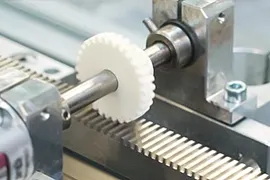
Our 3D printing materials are up to 50 times more abrasion-resistant than conventional plastic. This makes them the ideal material wherever components come into contact with movement. On this page you can find out which materials fulfil special requirements such as, e.g. food conformity or ESD suitability.
In our shop you will find detailed technical information and processing instructions for all our 3D printing materials. Material profiles are also available for download for easy processing of our filaments on standard 3D printers from Bambu Lab, Prusa and Ultimaker.
All-rounder 3D printing materials
The iglidur 3D printing materials are all-rounders that can be used for any type of wear application under normal conditions.
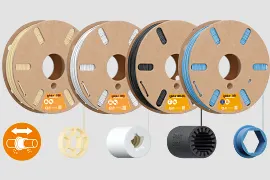
The bestsellers here are the laser sintering powder iglidur i3 and the tribofilament iglidur i150.
If, on the other hand, an all-rounder material with significantly higher flexural strength and/or temperature resistance is required, iglidur i230 is the right material for your application.


Heat-resistant 3D printing materials
This category includes 3D printing materials that can withstand a permanent application temperature of at least 120°C (without deforming): For such higher application temperatures, we offer wear-resistant tribofilaments and laser sintering powders.
What needs to be considered when processing heat-resistant tribofilaments?
- To process high-temperature filaments, you need a 3D printer with a build chamber temperature of at least 160°C.
- It is particularly important to store the high-temperature filaments protected from moisture and to dry them before use in order to avoid undesirable quality problems.


ESD suitable 3D printing materials
Electrostatic dissipative (ESD) materials are essential for protecting sensitive electronics and meeting ATEX requirements. The new iglidur i9-ESD offers lower conductivity than i8-ESD, preventing unwanted discharge between components—ideal for electronic connectors.
Both i8-ESD and i9-ESD feature high stiffness for minimal deformation under load and contain solid lubricants for low friction, eliminating the need for additional lubrication.


Food-safe 3D printing materials
Our 3D printing materials also include some with food conformity for safe use in the food and packaging industry. Food conformity guarantees that materials that come into contact with food have been tested for the level of transferred plastic components. EU Regulation 10/2011 and the FDA in the USA stipulate limit values for this, above which the material is no longer food-safe. The permitted contact time also plays a role and varies depending on the FDA or EU 10/2011 declaration of conformity and ambient temperature.
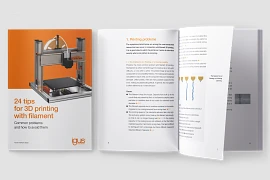
Tips for 3D printing with food-safe tribofilaments:
- Protect food-compliant filament from dust
- Thoroughly clean all contact parts before printing, especially the extruder pinion, print nozzle and print bed
- Do not use any adhesive or use food-grade adhesive
- Select slicing software settings for a dense surface
- Reduce the printing speed and adjust the line width to the nozzle diameter


Materials for structural components and multi-material printing
igumid P150 and P190 are fibre-reinforced 3D printing filaments designed to work with iglidur i150 and i190 in multi-material printing. They combine high wear resistance and low friction with exceptional rigidity, making them ideal for strong, lightweight structural components. The materials bond seamlessly to create durable, high-performance parts.


DLP and LCD resin
The iglidur 3D printing resins particularly stand out from conventional resins due to their enormous wear resistance and maximum strength.
Thanks to the integrated solid lubricants, they are self-lubricating and are particularly suitable for the production of wear-resistant parts with the finest details.
Like the other igus 3D printing materials, the resins are also processed to order in the in-house 3D printing service. They are also available as a material in the shop and can be processed on DLP and LCD 3D printers.


Our materials at a glance
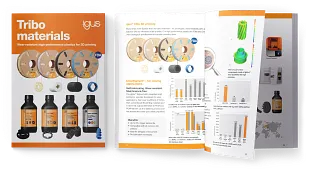
This brochure offers assistance in the selection and application of our wear-resistant tribo-materials, explains the advantages of the special filaments and 3D printing resins from igus, as well as specific application possibilities.
Just fill in the form, download the PDF and discover the materials!
Contact us
Contact details

Alan Hicks07467 956571Contact us
Opening hours
Office hours
Monday to Friday from 8 am - 8 pm.
Live chat:
24h