Change Language :
Motor Cables for Movement in Energy Chains
Engineered for maximum reliability in demanding environments
We offer over 260 motor cable variants engineered for continuous movement in energy chains. Designed for reliable motor power supply, the range includes spindle and single-core cables, as well as cables with three-phase conductors (L1, L2, L3) with or without a protective earth (PE). Optimised insulation and shielding ensure low capacitance and maximum EMC performance. Our portfolio also includes medium-voltage and highly torsion-resistant motor cables. With bending radii as low as 7.5 × d, these cables handle tight spaces and high mechanical stress.
Browse chainflex® motor cables


Single-core cables
Single-core cable designs are now an efficient alternative for large drives, offering key advantages over traditional four-core versions. A more cost-effective manufacturing process enables lower pricing, while the design itself is more robust and better suited to the limited installation space in energy chains, especially over long travels.
Smaller core diameters also simplify motor connections, although specialised mounting is required. With extensive experience in these applications, igus® provides the expertise and readily available products needed to deliver the right solution.
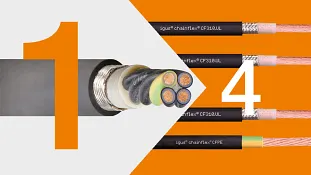
Applications with chainflex® cables




Frequently asked questions regarding motor cables
An SY cable is used for applications where mechanical protection is required.
igus® does not produce SY cables, why? SY stands for steel wire braided, and the galvanised steel wire braid are not designed to withstand repeated bending or flexing as the steel braid can fracture or unravel over time.
Alternatively, we offer our e-chains® as mechanical protection. igus® also provide CY and YY cables.
chainflex® continuous flex cables meet global standards including UL, CE, EAC, NFPA 79, and cleanroom ISO Class 1. They also support major communication protocols such as PROFINET and PROFIBUS.
By using specialised designs for continuous flexing, chainflex® cables minimise insulation cracks, conductor breaks, and EMI issues. This means fewer cable failures, less machine downtime, and higher production efficiency.
Yes. Depending on the cable type, they are available with oil-resistant, UV-stable, flame-retardant, and halogen-free materials, making them suitable for harsh industrial environments.
igus® provides free online tools including a service life calculator and cable configurator. These help you select the right cable and predict its performance in your specific application.
Yes. Engineers and purchasing managers can request a free cable sample box to evaluate product performance before committing to larger orders.
Yes. With the igus® readycable® service, cables can be ordered pre-harnessed with connectors from brands like Siemens, Beckhoff, Allen Bradley, and SEW, ready for plug-and-play installation.
igus® offers more than 1,394 cable types, available with no minimum order quantity. You can order by the foot (or meter), and most ship within 24 hours.
Motor cables nearly always have the same structure. Depending on the requirements, single core or multi-core motor cables are used. Both types of cables are suitable for high loads. So, what is the difference?
Why is there a different core structure?
Spindle drives in processing and machine tools are becoming increasingly larger and more demanding in terms of performance and energy supply. As a result, larger cable cross sections and thicker motor cables are required. To that end, however, cables used in energy chains no longer fit into the existing installation space of a machine. The cables need to change.
Single wire versus multi-core motor cable
Cost-effective and space-saving are the two main features of a single core compared to a multi-core motor cable. Single core cables can be produced significantly cheaper than the four-core alternative. Due to the smaller diameter, faster processing speeds are achieved, which ultimately has a positive effect on production costs.
In addition to the costs, the topic of size in a small installation space can be particularly important.
Both factors make the use of single cores in energy chains on processing and machine tools particularly attractive.
The single core cable in use
A machine tool customer recently looked for a solution for the following problem: a high-performance milling spindle mounted on the motion axis of a machine head. However, there was no space for a suitable high-end supply cable. Therefore, by using a new chainflex® spindle cable, the energy chain bend radius could be minimised by 40%, which made a huge difference to the required space.
Recommended for you


Contact us
Contact details

Opening hours
Office hours
Monday to Friday from 8 am - 8 pm.
Live chat:
24h