Change Language :
Food safe 3D printing filament and SLS materials
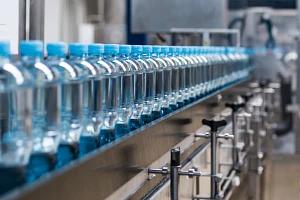
3D printing materials and service for applications with food contact
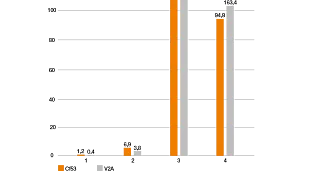
It is important that 3D printing can be offered in accordance to the requirements of the FDA and/or EU directive 10/2011. igus® has a range of food safe 3D printing filaments and SLS materials. Not only that, they are up to 50 times more abrasion-resistant than commonly used 3D printed plastics.
3D printing in igus® materials means that the parts can be used as moving parts and as no lubrication is required, thanks to the integrated solid lubricants, these are not only cost -effective but can be produced quickly.
You can configure your 3D printed part for free using our online configurator.
Shop abrasion-resistant, food safe 3D printing materials


iglidur® I150 – Easy-to-use tribo-filament for food safe 3D printing
iglidur® I150 is the most user-friendly tribo-filament, compatible with all standard 3D printers and as easy to process as PLA or PETG. It’s ideal for the food and packaging industry, thanks to its EU 10/2011 compliance for food contact.
Key features:
- No special equipment required – works with regular 3D printers
- Food-safe and wear-resistant
- Available in 8kg reels – perfect for large-scale printing
- Max continuous use temperature: 65°C
- Not recommended for highly dynamic applications
Further solutions for food contact


Requirements and standards for food-safe filaments
verified
What certificates are available?
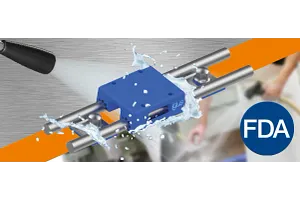
Safety in food production is regulated by strict legal requirements to ensure hygiene, quality and product safety. EU Regulation 10/2011 and FDA certification are particularly relevant for food-safe filaments. They set definitions and limits for safe use in direct contact with food. Specific hygiene guidelines, such as the HACCP concept (Hazard Analysis and Critical Control Points), as well as hygiene standards, such as those of the EHEDG (European Hygienic Engineering and Design Group), also play an important role. igus offers food-safe filaments specifically for these requirements.
euro
EU Regulation 10/2011
EU Regulation 10/2011 is the central European standard for the regulation of materials that come into contact with food. This food-safe certificate includes
- migration limits: The regulation sets strict limits on the maximum amount of substances that may migrate from a material into the food.
- Material testing and documentation: Manufacturers must provide comprehensive documentation on the composition and safety of the materials.
- Traceability: To ensure transparency throughout the entire supply chain, every stage of material processing must be fully documented.
place
FDA certification
The Food and Drug Administration (FDA) analyses the chemical properties of materials with regard to specific food groups, such as fatty, alcoholic or highly acidic products.
In order to obtain authorisation, manufacturers must prove that no harmful substances migrate into the food. This is done through migration tests with different food groups. The aim is to guarantee product safety under realistic conditions and ensure compliance with strict limit values.
clean_hands
Hygiene guidelines: HACCP and EHEDG
The HACCP concept is a legally regulated self-monitoring system for food companies that ensures food safety and protects consumers. It comprises key components such as incoming goods inspection, temperature monitoring, cleaning and disinfection, pest control, traceability and staff training. The aim is to guide companies towards the systematic and hygienic handling of food.
Hygienic design according to EHEDG is an internationally recognised concept for the design of production facilities with food contact, which aims to prevent contamination through measures such as smooth surfaces, suitable materials and easy-to-clean geometries. It is based on EU regulations and EHEDG guidelines that regulate materials, surfaces and geometries so that equipment is easy to clean and hygienically safe. The aim is to improve food safety while making cleaning processes more efficient.
Frequently asked questions about 3D printing with food-grade plastics
The material is food-safe if it meets the requirements for food conformity according to the EU standard 10/2011 or the specifications of the FDA (U.S. Food & Drug Administration), it is confirmed by a declaration of conformity. The specifications for the use of the respective substance are noted there.
Some 3d printing plastic material is food safe when they meet the requirements for food conformity according to the EU standard 10/2011 or the specifications of the FDA (U.S. Food & Drug Administration).
igus® manufacture a variety of 3d print filaments and SLS materials that can be used in applications with food contact. They also manufacture, compliant energy chains, bearings, guide rollers and more.
It means that the material coming into contact with food has been tested for a possible transfer of particles of the plastic to the food, whereby a defined limit value has not been exceeded. On the European market, the requirements for plastics to achieve food conformity are regulated by EU Regulation 10/2011, in the U.S. by the FDA (U.S. Food & Drug Administration).
igus® manufacture filaments that meet the requirements for food conformity according to the EU standard 10/2011 or the specifications of the FDA (U.S. Food & Drug Administration). The filament can be purchased direct from igus, or can be selected in the 3d printing service to configure and buy your custom parts.
Before and during printing, the food-grade material must be protected from dust. We therefore recommend an enclosed installation space.
The material should be stored in a dry place and protected from environmental influences. It should also be removed from the packaging in a dust-free environment and dried before printing. Drying prevents the moisture contained in the filament from degrading the material when it melts in the nozzle and prevents air pockets from forming. This ensures that the surface finish and quality remain the same. Tips on filament drying can be found in the processing instructions on the individual product pages in the igus filament shop. A good rule of thumb is a drying temperature that does not exceed the maximum application temperature of the plastic, but also does not damage the plastic spool. It is easy to dry the filament in a standard household convection oven, and also in a specially designed dry air oven.
Regular maintenance and cleaning of the printer is essential to ensure that the 3D printing filament can be processed without any problems. All parts that come into contact with the filament should be free of residue. This is particularly important for the extruder pinion and the print nozzle. The manufacturer of desktop 3D printers Ultimaker provides some cleaning routines for its devices that can also be used on other devices. In addition to the pinion and nozzle, a clean print bed is also essential; we recommend a clean glass plate. Adhesives should not be used unless a food-safe adhesive is available.
To achieve optimum results when 3D printing food-safe components, the print settings in the slicing software (e.g. Bambu Studio, Orca Slicer or Ultimaker Cura) should be selected in such a way that the surface of the object is as dense as possible. To achieve this, we recommend reducing the printing speed and adjusting the line width to the nozzle diameter. This can reduce unevenness in the component surface and gaps in the cover layers. The material must also be protected from dust before and during printing, which is why a printer with a closed build chamber is advisable.
We recommend that food-compliant components are not produced in multi-material printing together with other, non-food-compliant materials, as mixing of the materials cannot be completely ruled out. Accordingly, the support material should also either be food-compliant or the same material should be used as the support material.
The information on this page contains tips on 3D printing of food-safe plastic components, but does not replace the necessary knowledge on the part of the user as to which food conformity requirements exist in the specific application. Depending on the application and requirements, tests on the specific component may also be necessary. It is also recommended that the declaration of conformity is checked carefully for the application, as there are major differences in the food sector with regard to permitted temperatures and the permitted contact duration.
To optimise the processing of igus filaments, we provide our customers with preset configurations in the form of free print profiles for download, which are specially adapted to common 3D printers such as Bambu Lab, Prusa and Ultimaker. Simply import them into the slicing software and start printing.
More about 3D printing at igus

Sample box
See our materials for yourself and order a sample box with various 3D-printed parts.

Printing profiles
For optimum processing of igus filaments, we offer the material profiles for common printer models free of charge for download.

3D printing tips
No more stringing, warping and spaghetti: With our 24 tips, you can easily avoid the most common problems in filament printing.
Contact us
Contact details

Alan Hicks07467 956571Contact us
Opening hours
Office hours
Monday to Friday from 8 am - 8 pm.
Live chat:
24h