Change Language :
Plain bearing installation and tolerances
Installation of plastic plain bearings
Plastic bushings—such as iglidur plain bearings—are typically installed using a press fit, with exceptions including clip-in and two-hole flange designs. For high-volume production, automated assembly is generally the most efficient approach, while manual installation is often better suited to smaller batches. During assembly, it is important to maintain the recommended installation tolerances, as undersized housing bores can significantly increase insertion force and risk damaging the bearing, especially when aiming for an interference fit or minimal running clearance.
It is important that attention is taken to ensure the housing bore is free from sharp or contaminated edges; deburring the bore entrance is highly recommended to prevent bearing damage and to support a smoother, more reliable press-fitting process.
What tolerance should I use?
iglidur® plain bearings are designed as press-fit components. with press-fit oversize reaching up to 2% of the bore diameter to ensure secure retention and prevent axial or radial movement.
- housing bore tolerance- H7
- Shaft tolerance- h9
- Press-fit over size up to 2% of ID
- Use flat press only.
- Avoid centring pins
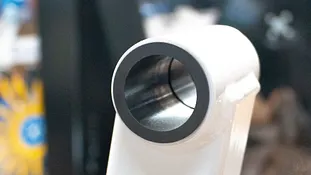
ISO tolerance chart for iglidur plain bearings [mm]
| Diameter d1 | Housing H7 | Shaft h9 | E10 (tolerances according to ISO 3547-1) | E11 (tolerances according to ISO 3547-1) | F10 (tolerances according to ISO 3547-1) | D11 (tolerances according to ISO 3547-1) |
|---|---|---|---|---|---|---|
| up to 3 | +0.000 +0.010 | -0.025 +0.000 | +0.014 +0.054 | +0.014 +0.074 | +0.006 +0.046 | +0.020 +0.080 |
| > 3 up to 6 | +0.000 +0.012 | -0.030 +0.000 | +0.020 +0.068 | +0.020 +0.095 | +0.010 +0.058 | +0.030 +0.105 |
| > 6 up to 10 | +0.000 +0.015 | -0.036 +0.000 | +0.025 +0.083 | +0.025 +0.115 | +0.013 +0.071 | +0.040 +0.130 |
| > 10 up to 18 | +0.000 +0.018 | -0.043 +0.000 | +0.032 +0.102 | +0.032 +0.142 | +0.016 +0.086 | +0.050 +0.160 |
| > 18 up to 30 | +0.000 +0.021 | -0.052 +0.000 | +0.040 +0.124 | +0.040 +0.170 | +0.020 +0.104 | +0.065 +0.195 |
| > 30 up to 50 | +0.000 +0.025 | -0.062 +0.000 | +0.050 +0.150 | +0.050 +0.210 | +0.025 +0.125 | +0.080 +0.240 |
| >50 to 80 | +0.000 +0.030 | -0.074 +0.000 | +0.060 +0.180 | +0.060 +0.250 | +0.030 +0.150 | +0.100 +0.290 |
| >80 to 120 | +0.000 +0.035 | -0.087 +0.000 | +0.072 +0.212 | +0.072 +0.292 | +0.036 +0.176 | +0.120 +0.340 |
| > 120 up to 180 | +0.000 +0.040 | -0.100 +0.000 | +0.085 +0.245 | +0.085 +0.335 | +0.043 +0.203 | +0.145 +0.395 |

Common mistakes you will want to avoid
Poor tolerance selection can lead to a lot of issues such as premature wear, shaft damage, increased friction, reduced service life.
Using anything other than a flat press fit tool for the installation is likely to cause issues.
The problems that could arise if this is the case:
- weld-line cracking
- ovality
- oversized final ID
- excess clearance
- reduced bearing life
This is a massive issue. Measuring the bearing outside of the housing will measure incorrectly. The final ID only forms after having been press-fit into the H7 bore.
A lot of the time, the shaft is over looked in regards to the tolerances. The most common mistakes are:
- rough stock bar
- oversized shaft
- poor roundness
- wrong tolerance class
- bad surface finish
- all of these will mean too much play, increased wear, possible stick-slip and likely noise.
Various bearing press-fit methods
Hydraulic or mechanical
The most common method is the mechanical press-fit of the plain bearing using a hand press. A flat press-fit punch is used to press the plain bearing into the housing bore. A centring or calibrating pin should not be used, as this may lead to cracks along the weld line and a larger bearing clearance.
Without a press
If no press is available or circumstances do not allow the use of a press, the plain bearing can be carefully assembled with a rubber mallet. A piece of wood between the plain bearing and the wood can help to protect the bearing from damage.
Automated assembly
When implementing (partially) automated assembly, the correct feeding and positioning of the components is particularly important. It can make sense to optimise the component geometry for the process. With plastic plain bearings, there are virtually no limits to the design. Geometries with conical diameters, grooves or anti-rotation devices can be realised cost-effectively.
Important information to know

Shrinking
Cooling the plain bearings can help to make plain bearings easier to press-fit. The bushings are cooled using liquid nitrogen, shrink together and are therefore easier to fit. Before shrinking, the bearings must be thoroughly cleaned and checked for damage. Once they have been reheated, the material expands again and the bearing sits firmly in the housing bore.
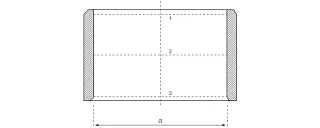
Checking the bearing seat
iglidur plain bearings are press-fit bearings for housings with an H7 unit bore. This press-fit of the bearing secures the bearing in the housing on the one hand, and on the other hand the inner diameter of the plain bearing is formed as a result. The bearing is tested, installed in the hole with the smallest dimension, both with a dial gauge and with a plug gauge.
- Pressed into the hole, the good side of the plug gauge must pass the bearing smoothly
- With a slide tester, it should be ensured that the inner diameter of the bearing must be within the specified tolerance on average at the measuring planes (see diagram opposite)
Locating spigot
Plain bearings actually "migrate" out of the housing bore if the press-fit is lost. Plain bearings are often fastened by press-fit in a slightly narrower tolerance housing. Under mechanical tension, the bearing sits firmly in the hole. If this mechanical tension is reduced due to high temperatures or permanent exceeding of the permissible load, the press-fit is also reduced.
Of course, it can also happen that the manufacturing tolerances of the housing bore are so inaccurate that the hole is not sufficiently undersized. In this case too, the bearing cannot build up sufficient tension to create an press-fit. The result is extreme wear of the plain bearing. The solution to the problem is a locating spigot of the plain bearing. You can find out what options are available for axially securing the plain bearings in our factsheet under the topic "locating spigot".
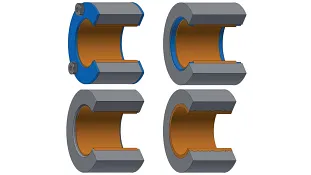
Gluing in plain bearings
Plain bearings are usually pressed or clamped into the housing bore. This ensures that they sit firmly in the hole and do not rotate unintentionally. But what if this is not possible due to manufacturing tolerances? Or if the plain bearing is even supposed to rotate?
Even if it is not part of the standard repertoire of many plain bearings, plastic bearings can also slide on the outer diameter. This is why plastic bearings are used. The bearing is placed on a bolt and should then - together with the bolt - rotate in something or roll on something. Gluing seems to be a good solution. But there are probably as many adhesives as there are bearing materials. Which is the right one?
Guidelines for machining
iglidur plain bearings are supplied ready for installation. The comprehensive product range allows the use of standard dimensions in most cases. If subsequent machining of the plain bearing is nevertheless necessary, the adjacent table shows the machining guidelines. If possible, however, subsequent machining of the sliding surfaces should be avoided. Higher abrasion is usually the result. One exception is e.g. iglidur M250, which is very suitable for subsequent machining. With the other iglidur plain bearings, the disadvantages of machining the sliding surfaces can be counteracted by using assembly lubrication.
| Process | Turning | Drilling | Milling |
|---|---|---|---|
| Tool material | Stainless steel | Stainless steel | Stainless steel |
| Feed rate [mm] | 0.1 ... 0.5 | 0.1 ... 0.5 | to 0.5 |
| Clearance angle | 5 ... 15 | 10 ... 12 | |
| Clamping angle | 0 ... 10 | 3 ... 5 | |
| Cutting speed [m/min] | 200 ... 500 | 50 ... 100 | up to 1000 |
Frequently asked questions
We advise you use a H7 housing bore tolerance for standard press-fit installation. This ensures the correct interference fit and allows the bearing inner diameter to form correctly after installation.
This is a common question! This is nominal. ID is achieved only after press-fit into a bore with a H7 tolerance. If, after press-fit the ID is still too small then possible causes can be:
- undersized bore
- centring pin use
- no chamfer
- soft housing material deformation
One of the most common reasons is that the housing bore is oversized or out of H7 recommended tolerance. Temperature expansion, excessive load, or soft housing materials can also reduce press-fit retention.
We recommend a minimum shaft tolerance of h9 for most standard iglidur applications. Final selection depends on factors such as required running clearance, load, and environmental expansion factors.
igus® uses a plug gauge test, also known as a "go/no-go test", to ensure that our bearings meet the specifications and function properly after installation.
First, the bearings are pressed into a test fixture. It is important to ensure that the bearings are installed without damage. A bevelled edge is recommended for this - ideally 25-30 degrees. It is also advisable to use a press with a flat press to press in the bearing. This is the most efficient installation method. It also ensures the integrity of the bearing. If you use a hammer, for example, the bearing can tilt during installation.
1.2 igus® recommends using a press to install a plain bearing.
After the bearing has been installed, the actual plug gauge test is carried out. A "Go" means that the bolt falls through the bearing under its own weight, while a "No-Go" means that the bolt does not fall through the bearing or remains stuck. As a rule, the plug gauges are graduated to 0.01 mm, so that it is possible to determine very precisely from which dimension the respective plug gauge hangs.
A plug gauge test is the quality check with the greatest possible accuracy because the bolt behaves like a shaft in a real application and reflects the narrowest cross section of the bearing. It is precisely this aspect that is usually decisive for the application. Plug gauge tests are particularly suitable for plastic bearings, as the irrelevant "unevenness" of the bearing caused by injection moulding is not taken into account. Later in operation, during the running-in phase, when the unevenness of the bearing and the shaft is smoothed out, an ideal sliding surface is created.
The quality control of a bearing can also be carried out using other tests; however, inaccuracies can occur when these methods are applied to plastic bearings. In particular, the use of gauges should be avoided. Gauges should generally only be used for cursory quality checks, depending on the degree of accuracy. Depending on the pressure exerted by the gauge on the measuring point, the measurement may be falsified. A plug gauge test is therefore much more reliable.
Depending on accessibility, the described test can also be carried out directly on the series component (i.e. not in a specially manufactured test fixture)
In standard cases, we have had very good experiences with instant adhesives (e.g. Loctite 401). With materials that are difficult to bond, such as iglidur® J, significantly better results are achieved with 2-component systems (e.g. Loctite 406 + Primer 770). We have had good experiences with epoxy resin systems (e.g. Hysol) for applications with increased temperatures.
Furthermore, it is important for every bonded joint that the workpieces are thoroughly cleaned and free of grease. This can be done with professional cleaners, for example, but also with simple quick degreasers. Roughening the contact surfaces also supports the bonding effect.
In general, bonding can only have a supporting effect and cannot completely replace the press fit.
iglidur®Plain bearings are press-fit bushings. The inner diameter is only set after pressing into the H7-housing bore with the corresponding tolerance. The press-fit interference can be up to 2% of the inner diameter. This ensures a secure press fit of the bearing. Axial or radial displacements in the housing are thus reliably avoided.
The hole in the housing should be manufactured to tolerance H7 for all bearings and be as smooth, even and chamfered as possible. Assembly is carried out with a flat press. The use of centring or calibration mandrels can damage the bearing and lead to greater clearance.
Bearing wear means material removal on the sliding surface, i.e. usually on the inner diameter of the bearing.
The clearance between the bearing and shaft is calculated from the tolerances of the bearing and shaft.
The actual starting clearance during commissioning is the difference between the measured actual inner diameter of the bearing and the measured actual outer diameter of the shaft. Wear on the bearing inner diameter leads to an increase in diameter and thus to an increase in clearance.
As iglidur® plain bearings do not have a layered structure and therefore the entire wall thickness is available as a wear zone, there is no wear limit specified by the bearing. Instead, the wear limit is determined by the maximum clearance permitted in an application. This can vary greatly depending on the application and user requirements. Precision control valves, for example, only allow a few hundredths of wear (and therefore an increase in play). In agricultural applications with shaft diameters greater than 50 mm, a clearance of significantly more than one millimetre is often uncritical.
Contact us
Contact details

Opening hours
Office hours
Monday to Friday from 8 am - 8 pm.
Live chat:
24h