Change Language :
Thrust bearing
Thrust bearings provide a lightweight,, maintenance-free alternative to traditional metal bearings. These bearings are designed for low friction, minimal wear and to deliver a smooth motion as well as a reliable performance without the need for additional lubrication. Their dry-running properties make them clean operational and ideal for hygiene-sensitive environments including;
✅ Medical
✅ Food applications
✅ Packaging machinery
✅ Conveyor systems
...as well as a wide range of industrial systems that require maintenance-free, efficient and lubrication-free movement.
Thanks to continuous testing, the wear, service life, reliability and robustness of these thrust bearings are proven and supported by recorded data.
Thrust bearing types


What are thrust bearings?

How are thrust ball bearings constructed and what are their advantages?

Are roller bearings the same thing as thrust bearings?
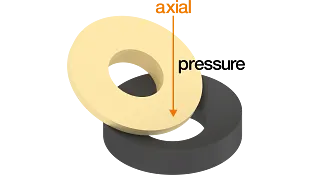
Despite the fact that they are commonly mistaken for the same item, they actually serve different purposes and shouldn't be confused with each other. Key differences are the roller bearing is specifically designed to take radial loads and the thrust bearings axial loads, so different directional forces.
To see an overview of all our bearing types click below.
Thrust ball bearing dimension table
| Installation size | Interior ⌀ [mm] | Exterior ⌀ [mm] | Width [mm] |
|---|---|---|---|
| 51100 | 10 | 24 | 9 |
| 51104 | 20 | 35 | 10 |
| 51104 (double row) | 20 | 47 | 10 |
Frequently asked questions about thrust bearings
A thrust bearing is a rotary bearing that supports axial loads, reducing friction and stopping shafts from shifting.
If there is an issue with the thrust bearing you may experience unusual noises, grinding or squeaking noise and excessive wear.
Thrust bearings are usually used as a support absorbing axial loads. They work through distributing the load to allow for smooth rotating movement.
Ensure the right orientation is selected, the housing is clear and dirt free and depending on the application, usually mount the thrust bearing against the fixed shoulder of the shaft.
Depending on where the thrust bearing is depends on how you replace them. Normally you will have to remove the old one, see if there has been any wear and if not replace it with a new one but it depends where the thrust bearing is within the application
Thrust bearings can fail due to a variety of reasons. These include dirt, lack of lubrication in metal thrust bearings, misalignment, ill-fitting assembly, wrong material choice.
A thrust ball bearing is a special rotary bearing designed to support axial loads.
You will find thrust bearings in loads of applications but one of the biggest industries is the automotive industry, where thrust bearings are found in clutches and gearboxes. They are also commonly found within medical, food and packaging, and conveyor applications.
To check the thrust bearing clearance you will need a dial indicator.
Thrust bearings are used when high stiffness, low centrifugal forces and low to medium speeds are required. As a rule, this type of bearing is not suitable for radial loads. If necessary, they are combined with radial bearings. Radial bearings are designed in such a way that they withstand the forces acting vertically on the shaft but can also absorb radial forces at high speeds. Some rolling bearings are able to tolerate radial and axial forces that act on a shaft.
Contact us
Contact details

Alan Hicks07467 956571Contact us
Opening hours
Office hours
Monday to Friday from 8 am - 8 pm.
Live chat:
24h