Change Language :
Services in the area of harnessed cables | readycable®
Here you will find detailed information about the services that igus offers in connection with harnessed cables.
Learn more about the field of machine-assisted soldering. Frequently asked questions such as: "What are the soldering processes available?" are answered and with the help of the white paper you can delve even deeper into the topic. EPLAN offers enormous cost-saving opportunities because the data can be collected and accessed directly in one place. If you need help choosing the right harnessed cable or have a request for a very specific harnessing, then we would also be happy to help you through a personal discussion. You may decide how the communication should take place.


Ready-to-connect cables for drive technology/harnessed servo cables
With nearly 6,000 harnessed motor, servo, signal and encoder cables that can be used in energy chains and are suitable for over 40 manufacturer standards, igus has the right drive cable for almost any application. The selection of drive cables is so large because there are up to seven cable qualities per cable specification. This is not a one-size-fits all approach; instead, you select the optimum cable based on the application conditions and where the cable is to be used. Whether icy temperatures (down to -40°C), oil or limited installation space dictate the choice of drive cable, you will always find the most favourable and suitable harnessed servo cables for your application with the help of the seven cable qualities. A 4-year guarantee or 100 million strokes in the energy chain provide additional protection. The third pillar for choosing the right drive cable is the online Long Life Calculator. With just a few clicks, the service life of the drive cable is calculated to suit the application.
Go to the shop for drive cables that are suitable for over 40 manufacturer standards
All manufacturers in alphabetical order


Find the right drive cable quickly with the readycable finder


Find your matching extension cable

The right extension cable in 3 steps
If the matching extension cable exists for the basic or connection cable, this is displayed
- When changing the installation paths.
- Extend prefabricated drive cables instead of completely covering them again.
- If the igus® range for pre-assembled drive cables contains the extension cable that matches the manufacturer's standard, this is displayed under the suitable product.
- Shortens the search for the right cable many times over.


Customised cable harnessing with no minimum order quantity
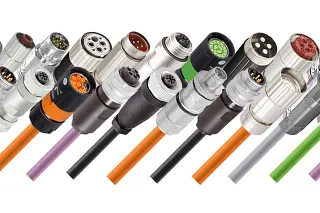
No matter which connector, no matter which cable, we produce the ready-to-connect solution
Our industrial cable-harnessing department manufactures over 10,000 customised cables every week exactly according to customer requirements. Industrial cable harnessing involves cutting the cable to a defined length and attaching clearly specified connectors. Standardised processes and maximum machine optimisation result in cables that are ready to connect - with no minimum order quantity and always produced with industrial and machine-supported manufacturing.
When the special case becomes the new normal
Arguments for customised cable harnessing by igus
Plug & play - one product instead of many individual parts
Optimise the procurement process: no need to buy packaging units
No need to acquire specialised knowledge or buy tools
High level of automation, which reduces manual errors
100% check with saved certificate before cable is shipped
Desired length accurate to the centimetre
No minimum quantity surcharges
Custom assembly is part of our daily business
100% customised and safe thanks to industrial cable harnessing
Your customised cable harnessing takes centre stage with us.
We produce ready-to-connect cables that are precisely tailored to the requirements and application - from simple single wires to complex assemblies. We attach great importance to precision, automation quality and flexibility.
Your desired cable length, special connector combinations or customised material specifications: we manufacture cables according to your specifications and support you during the entire process - from planning to production to the final 100% quality check of all cables produced.
In the end, you not only get a ready-to-connect and extremely durable cable, but also a reliable, customised connection solution that works.
If you already know the application parameters, you can already determine the service life of the cable.
Think about the setup of the e-chain® to match the cable


Shorter lead time with harnessed energy chain systems
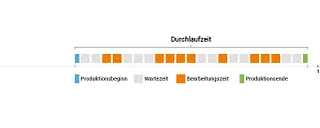
Exemplary process without readychain
Lead time is one of the most important parameters in industrial production. It is a reflection of costs, quality and delivery times. However, developers and design engineers also have to adapt to ever shorter product life cycles by shortening lead times in the design phase.
The lead time describes the time a process takes from start to finish. This can be small sub-processes as well as the entire process from order receipt to outgoing goods.
Calculating lead time
Lead time = waiting time + processing time
Waiting times might include:
- Set-up time
- Transport time
- Idle time
- Storage time
- Additional time
The pure processing time can be considered the value-adding part of the lead time and describes the time in which a workpiece is actually machined. Within production, it is the value-adding part. In practice, however, only a small part of the total process time is actual processing.
Save time with readychain
Why is the lead time so important?
In addition to its effect on delivery time, the lead time also significantly influences the costs of a product. According to the Kaizen principle, the elimination of waiting times and the value-adding use of internal resources in particular have a great influence on the selling price and margin of a product.
The igus readychain helps you increase the productivity of your factory while improving the quality of your products.
Why should you choose a readychain from igus?
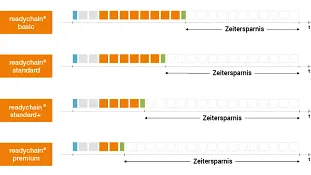
The assembly of complete energy chain systems often takes several days. With the igus readychain, you can reduce your lead times from several days to just a few hours. Thanks to sophisticated logistics, igus supplies ready-to-connect systems - quickly, efficiently and reliably.
What does soldering mean and what are the available soldering methods?
Soldering is a thermal process in which a non-detachable joint is created between materials using a solder.
The solder consists of tin and other metals, such as copper or silver, and is an easily fusible metal alloy that serves as a joining material between the materials. To join two metallic components, solder is melted and cross-linked with the stranded wire.
Soldering connection technology can be used flexibly and focuses on one requirement in particular: reproducibility. The quality depends on various parameters - for example, the constant temperature, the solder used or the size of the components. For example, free hand tinning is subject to certain fluctuations. At igus®, we want to realise soldered connections at a consistent level - with the help of professional soldering stations.
Soldering processes are categorised (according to DIN 8505) according to various aspects. A distinction is made between soft soldering and hard soldering: Soft soldering involves soldering with solders whose liquidus temperature is below 450 °C. Hard soldering, on the other hand, involves soldering with solders whose liquidus temperature is between 450 and 900 °C. Brazing, on the other hand, involves soldering with solders whose liquidus temperature is between 450 and 900 °C. Brazed joints are usually mechanically more stable than soft-soldered joints.
Why manual solder connections are good, but technically supported ones are better
This increases quality and safety, even with manual work
Both crimped and soldered connections are suitable for making electrical connections. The latter are usually favoured when electrical conductivity needs to be constantly ensured over a long period of time or when the connection point needs to be permanently sealed.
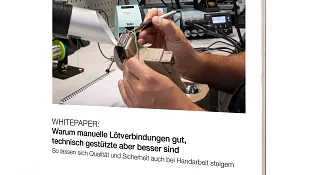
But be careful: soldering needs to be skilful. What often appears simple at first glance is, on closer inspection, a complicated process that needs to be mastered. The white paper presents the most serious errors in the production of soldered joints. Using the example of the harnessing of cable and cable carrier systems, it explains why technology-supported soldered joints are preferable to those made by hand in an industrial environment.
The paper also discusses the economic advantages resulting from the reproducibility of soldering results. It concludes with the risks that manual soldering entails for people and materials and how these can be minimised.
What are the advantages of machine-supported soldering?
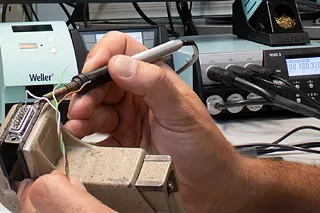
Professional soldering station at igus readychain
Mechanical engineers and system integrators who cannot rely exclusively on crimp connections must pay more attention to the quality of the soldered connections. This is the only way to ensure that the electrical conductivity of components remains constant over a long period of time and that the connection point is permanently protected, e.g. from the influence of gases or liquids.
There are also other advantages of machine-supported soldering:
- Reproducible quality
- Increased safety in the workplace thanks to integrated extraction systems
Advantages of industrial harnessing
No. 1 worldwide for chain-compatible drive cables
The igus® readycable® range extends from a large selection of cables in accordance with various manufacturer standards, such as Siemens, SEW or Beckhoff, to cables for video/vision technology and prefabricated Ethernet cables up to CAT7. You can realise the following cost benefits with each individual cable:
- Ready to connect directly from the cable manufacturer
- Up to 7 price classes with the same electrical specification
- In desired length: accurate to the centimetre
- No minimum order value, no minimum order quantity
- Ready for dispatch in 24 - 48 hours
- Customised assembly is part of our daily business
Quality prevails!
readychain® Application examples from practice

Already available for these drive manufacturers
(Bosch Rexroth, Siemens, SEW)
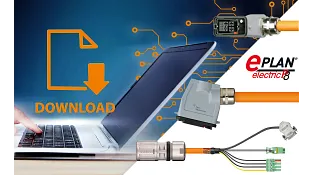
Using EPLAN macros can save you a lot of time spent on designing and purchasing as all important information is automatically loaded into the system for you and your colleagues.
We currently offer EPLAN macros suitable for the following drive manufacturers:
- Bosch Rexroth
- SEW
- Siemens
- Allen Bradley
- B&R
- Beckhoff
- Fanuc
- Heidenhain
Reduce the number of suppliers, including to your international manufacturing locations
readycable® Factories around the world
igus® manufactures more than 12,500 readycable® each week at 14 readycable® Factories around the world. In the Cologne factory alone, 180 people specialise on manufacturing readychains and readycables. The goal is to minimise transport routes, time and resources while ensuring consistent quality. The same production standards apply at all 14 sites.

Contact us
Contact details

Opening hours
Office hours
Monday to Friday from 8 am - 8 pm.
Live chat:
24h