Change Language :
3D printed components for therapeutic applications
Low friction, light and made to measure
According to the German Stroke Society, one person in Germany suffers a stroke every two minutes. The Swiss Federal Institute of Technology in Zurich (ETHZ) has developed a hand exoskeleton called RELab tenoexo, which covers up to 80 per cent of daily activities, to make it easier to learn to grasp again after a stroke.
On this page you will learn how 3D printed finger joints made from the high-performance plastic iglidur® i6 ensured optimum power transmission, allowed the flexibility of speed, design freedom and durability.
Requirement, challenge and solution


More information on the application
During development, the researchers encountered a challenge: the fine finger joints. These elements not only hold the leaf springs together, but also have a filigree closing mechanism for the leather strap. The buckle into which the strap is threaded is barely wider than a millimetre. A 3D printer with an ABS filament was used to produce the back of the hand - both the manufacturing process and the material proved to be unsuitable for producing the finger joints. The resolution of a conventional 3D printer also turned out not to be high enough to realise the detailed structure of the finger joints.
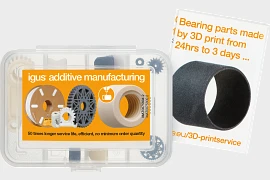
Further information on 3D printing



Contact us
Contact details

Alan Hicks07467 956571Contact us
Opening hours
Office hours
Monday to Friday from 8 am - 8 pm.
Live chat:
24h