Change Language :
iglidur® - bearing coefficient of friction
Coefficient of friction- what is it?
iglidur plain bearings are self-lubricating thanks to the addition of solid lubricants. The solid lubricants reduce the bearings coefficient of friction and therefore support the wear resistance. The coefficient of friction, expressed as μ, is proportional to the normal force and indicates the force that must be applied to move one body against another. Depending on whether a body is to be moved from its resting position or whether the existing movement is to be maintained, a distinction is made between the coefficient of static friction and the coefficient of sliding friction.
Bearing coefficient of friction under different loads
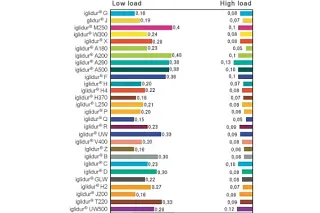
The bases for understanding how load affects the coefficient of friction is not as complicated as you may think. As load increases on the bearing, the coefficient of friction shifts, this is one of the most important design considerations when designing in specific plain bearing materials. Things to consider:
- Light loads, friction can occasionally be higher because the contact pressure is too low to create stable transfer layers.
- As loads rise, the coefficient of friction can decrease. This is because the bearing material forms a larger contact interface with the shaft.
- High loads, friction may begin to increase once again, resulting in heat generation and an increase in resistance.
- Friction should always be evaluated as a dependent on certain influences such as: pressure, shaft finish, speed, and temperature
Coefficient of frictions and surfaces
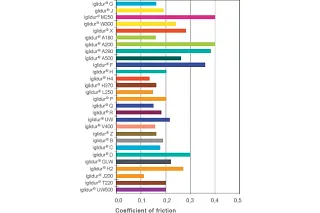
Coefficient of friction of the iglidur plain bearings at the recommended shaft surface finish and low load, p = 0.75 MPa
The relationship between the coefficient of friction and the surface roughness of the mating partner is interesting. Here it can be clearly seen that friction is made up of various components.
If the mating partner becomes too rough, abrasive processes play an important role. Small, interlocking irregularities in the surfaces must be removed. If the surfaces are too smooth, high adhesion occurs, i.e. the surfaces literally stick together. Higher forces are then required to overcome this, a consequence of the increased coefficient of friction. Stick-slip can be the result of a large difference between static and dynamic friction and a high adhesion tendency of sliding pairs. It manifests itself in uneven running behaviour and can also be noticeable through loud squeaking. It has been observed time and again that such noises can be avoided or eliminated with rougher shafts. For applications that have a particular potential for stick-slip - slow movements, strong resonances of the housing - attention should therefore be paid to the optimum surface finish of the shafts.
Further information to help understanding the best bearing for your application
Contact us
Contact details

Opening hours
Office hours
Monday to Friday from 8 am - 8 pm.
Live chat:
24h