Change Language :
chainflex® Know-How
Because we give you up to 4 years guarantee on our cables
What advantages do our cables offer?
- 30 years of experience
- Four-year guarantee
- Tested in our own laboratory spread over an area of 3,800m², 125 test systems, over 800 ongoing tests
- The largest range with over 1,350 cable types for data, bus and hybrid systems, control system and drive
- Predictable and configurable service life
- Available from stock, from 1m length within 36h
- Cables for any type of motion: horizontal, vertical, torsion, high speed
- Freely available samples
- 50% time reduction when stripping due to unique CFRIP technology
- Optionally with intelligent tensile force monitoring from smart plastics for exceptionally heavy-duty cables
7 basic rules for a good cable
There are 7 key rules to ensure that cables are at their optimum. Ensuring that all of these rules or considerations are taken into account, the life time of the cables within your application should be considerable.


Sectional views through the igus® cable types
Structure of igus® control, data, servo and motor cable from high class in detail


Since the middle of the 1980s, the technical requirements of energy chain systems on the part of the machine and plant manufacturers have been steadily increasing. Travels have become longer, movements quicker and bend radii smaller. Core and jacket damage, jacket abrasion and corkscrews were the consequences for machine builders and end customers. igus® faced the challenges and together with the University of Applied Sciences, Cologne, developed cables that could withstand a high degree of mechanical stress.
After extensive tests in the igus® test lab, it became clear that the cables with cores wound in bundles, short pitch lengths, high tensile strength centre elements and gusset-filling extruded outer jackets exceeded expectations. Meanwhile, the product range comprises over 1,350 cables for different application areas. Since 2013, igus® has guaranteed a service life of up to 4 years or up to 10 million double strokes, depending on which occurs first.
Cable identification according to DIN 47100
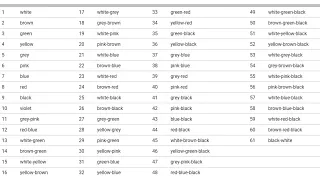
This standard regulates the colour coding of the core insulation of telecommunication cables.
The first colour indicates the base colour of the core insulation. The second or third colour indicates the colour of the printed ring. For multi-coloured cores, the identification consists of a base colour and a ring colour. As it is not possible to print on the small cross sections, this arrangement was chosen in order to be able to distinguish the cores uniformly.
Frequent cable defects in moving applications


Bring your tech up & cost down now with chainflex® cables and the price check
From low-cost solutions to high-end cables. Everything in line with our motto: Tech up, Cost down. It's our job!
igus supplies electrically identical cables with mechanically different qualities in the different cable areas. You can therefore achieve the optimum price/performance ratio for yourself. An example of a control cable with a core cross section of 4x0.5mm²:
- Control cable CF880, bend radius 12.5xd and PVC outer jacket: low-cost version
- Control cable CF5, smaller bend radius 6.8xd with PVC outer jacket and oil resistance: greater technical advantage leads to slightly higher price per metre
- Control cable CF98, cable resistant to oil/organic oil, with TPE outer jacket and a bend radius of only 4xd: higher price due to greater technical advantage
Benefit from our variety of cables. From low-cost solutions with PVC outer jacket to high-end TPE cables.
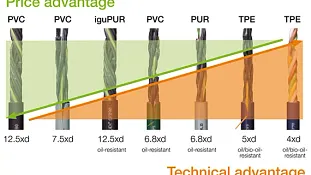
▲ Tech up
In the industry's largest test laboratory with 5,500m² of testing area and over 800 parallel tests on 64 systems, we perform more than 2 billion double strokes a year to provide you with the highest quality technology.


▼ Cost down
Thanks to a wide range of cables, we enable users to make major savings in every type of cable, whether as chainflex cables sold by the metre or pre-assembled readycable.



How do you save money by choosing the right outer jacket?
Every material has specific specifications; there is no one-size-fits-all good or bad material. Here we use the example of the PVC and PUR jacket materials to show which is best suited for what applications and provide specific ideas for reducing costs in this context.
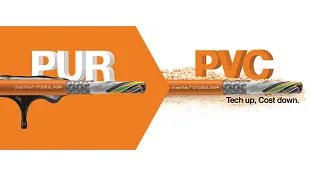
Safely replace PUR with cost-effective PVC
PUR (polyurethane) has decisive advantages as a jacket material in some areas, but not in all. Our aim is to provide enough information so that you can decide objectively whether a cable with PVC jacket is not only sufficient, but may be a better solution.
Advantages and properties of the two materials
Sample calculation of catalogue cables


PVC cables for movement
With more than 30 years of experience, countless tests and satisfied customers
If you need a cable specifically for movement, you quickly face the question of the ideal material for the outer jacket. People often tend to go for the more expensive PUR or TPE versions. But is this always the best choice? What about the material that seems to be omnipresent- the well-known PVC? igus has known the advantages of PVC for decades. PVC is the ideal jacket material for certain environments and operating conditions, and saves costs at the same time! You can find numerous details on PVC cables here.
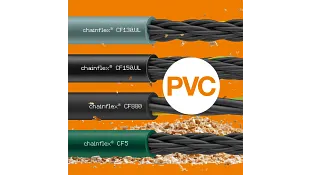
Our PVC cables
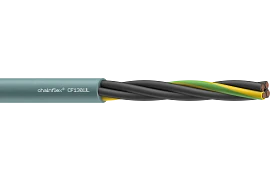


Did you know? The first chainflex cable was a PVC cable
The CF1 was the very first chainflex cable that was specifically developed for permanent use in energy chains. This cable happened to be a PVC cable and was part of our product range for a long time.
It was refined technically, and the PVC compounds were also constantly optimised. As a result, our portfolio now contains a large number of other PVC cables. We are experts and know which PVC cable is the right one for your application.
And we can prove it! Thanks to our continuous testing, we can give you a guarantee of up to four years on our cables. This makes us unique on the market to date!

The idea was born to develop a special performance product range for moving applications in the energy chain. The first chainflex control cable of the CF1 series with PVC outer jacket was developed in co-operation with the University of Cologne. Polyvinyl chloride (PVC) was chosen as the jacket material to launch the first cable series for use in the energy chain due to its excellent abrasion specifications, flame resistance and good customisability. Another characteristic feature of this cable is the principle of cores wound in bundles with short pitch lengths, which is still typical today and avoids wear and "corkscrew".
Katharina Wielpütz
Business Development Manager chainflex®
Advantages of PVC:


Changing large motor cables into compact single cores
In various areas, the use of single cores for motors has led to a considerable increase in the service life of cables. The costs for cable have also been significantly reduced.
We have prepared a video about this for you in our chainflex wiki.
Contents:
- The motor cable as a multi-core cable
- Single core with its greatest advantages
- What do I need to consider to achieve the best result?
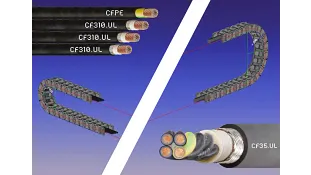
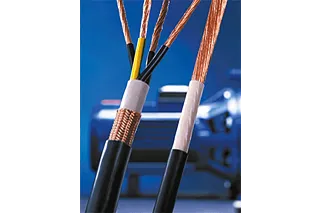
Single-core/Multi-core motor cables
Broken cores or defective shields are feared in industrial applications. This often causes machines to come to a standstill. igus designs its chainflex cables with mechanically high-quality copper conductors in an optimised pitch length to prevent such shutdowns. This core structure ensures a high load capacity compared to conventional motor cables. From a core cross section of 10mm², it is advisable to switch to single cores for energy chain systems, as these can be used in a smaller installation space, which also benefits the mechanical design of the entire energy chain system.
Cost-effective and space-saving are the two main features of a single core compared to a multi-core motor cable. Single cores can be produced much more cost-effectively than the four-core alternative. The smaller diameter means that faster processing speeds can be achieved, which ultimately has a positive effect on production costs.
In addition to the costs, the issue of saving space in tight installation spaces is particularly important. Both factors make the use of single cores in energy chains particularly attractive in a wide range of applications.
Sample calculation of catalogue cables



Defining data volumes correctly for Ethernet cables
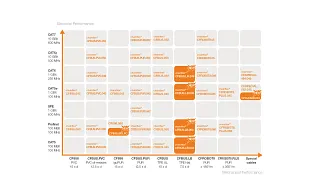
It is common practice to use the Ethernet cable with the highest possible category. However, this often means a high price and is not always necessary from a technical point of view. With this event, we want to convey an idea that choosing the right data transmission volume for cable can be a good option for saving money.
Variety of Ethernet cables for optimum service life
With the world's largest portfolio of Ethernet cables for motion, igus offers its customers the right choice for every application. Increasing automation in production is also increasing the amount of data that needs to be transmitted between individual components. At the same time, there is more and more movement in modern production processes, which is why cables specially designed for these purposes should be used. As the requirements for cables differ from application to application, we offer a complete product range of Ethernet cables specifically for motion. Depending on the required mechanical and electrical performance, users can rely on safe and tested cables and choose the most favourable cable from our range that is sure to work for them. From CAT5 to CAT7 transmission standards as well as simple linear or complex three-dimensional movement. Even applications with particularly high tensile forces can be realised - so we offer a suitable Ethernet cable for almost every application.
Sample calculation of catalogue cables


∎ Proof
And here are three concrete approaches for you to realise success quickly:


Online tools for chainflex® cables
With the useful online tools, you can find products according to your individual requirements, configure custom cables and calculate the service life.


chainflex® cables Wiki
The chainflex cable expertise pooled together - Find out more about the important technical and mechanical specifications of cables. We will also show you the special features of cables for motion and how to find the ideal cable solution for your application.


chainflex® safety and quality
The largest test lab for moving cables worldwide
The chainflex cables are tested on a floor area of 3,800m² and with two billion test cycles per year. Thanks to these extensive tests, reliability is guaranteed!
chainflex approvals and standards
We at igus make absolutely sure that our chainflex cables fulfil all guidelines and approval regulations and the most important standards worldwide. Here you can find the standards and approvals concerned, and in which regions of the world they play a special role.
Discover all standards and approvals.

Frequently asked questions regarding cables
The maximum tensile strain of a cable is particularly important where cables are used in hanging applications. This is because the cable has to bear its own weight. This is the case, for example, with a storage and retrieval unit (RBG) during the lifting movement.
The maximum tensile strain indicates the force up to which a cable can be loaded without danger, as well as the maximum free-hanging length at which the cable can still be used safely. Depending on the structure of the cable, different maximum tensile strains may result. The maximum tensile strength for cables with copper cores is specified by the VDE 0298-4 standard. Here, the maximum permissible tensile strength for standard cables is defined as 15N per square millimetre cross section of the sum of the main cores.
A calculation example can illustrate the situation:
Assume a CF21.25.15.02.02.UL, i.e. a servo cable with a structure of (4G2.5+(2×1.5)C)C, is to be used hanging for 25m in an application. First, the weight of the cable must be calculated:
F = m x g x l = 0.271kg/m x 9.81m/s² x 25m = 66.5N
How high can the cable be loaded? The main cores have a cross section of 2.5mm², i.e:
4 cores with 2.5mm² cross section each -> 4 x 2.5mm² = 10mm²
10mm² x 15N/mm² = 150N max. permissible tensile strain
As the weight force of 66.5N is less than the maximum permissible tensile strain of 150N, the cable can be used in this application.
With small cross sections, such as those found in bus cables, the permissible load limit is quickly reached. For this reason, igus offers optimised cables especially for applications with particularly high tensile strains. A good example of such a cable is the CFSPECIAL182.045, a CAT5e Ethernet cable. Due to its special structure with an aramid braid in the two-layer outer jacket, this cable is particularly suitable for applications with very high tensile strain, e.g. in hanging installations.
The aramid braiding integrated in the outer jacket ensures that the tensile strain does not act on the inside of the cable, but is absorbed in the braiding. This ensures a longer service life and the good functionality of the cable. Enormously high tensile forces also occur in other applications, such as in forklifts. In such cases, detailed testing and analysis is required to find a suitable solution. The type of movement in this application is also different, as the cable is guided by rollers.
Taking the maximum tensile strain into account is crucial when selecting the right cable. If this is not considered, the cable may elongate, which can lead to defects and, in the worst case, to machine failure.
In electrical engineering, the term medium voltage is used when the electrical voltage is between 1,000V (1kV) and 30,000V (30kV). Depending on the technical standard or country, this voltage range may vary slightly as the term "medium voltage" is not clearly defined everywhere.
In our power grid, medium-voltage networks serve to supply a region with electrical energy. Medium-voltage networks are not used for supra-regional electricity exchange. They are the voltage levels between the high-voltage grid and the building installation. Larger electricity customers, such as industrial companies, hospitals, large swimming pools and larger broadcasting towers, usually have their own medium-voltage connections with an in-house transformer station. For railway power supplies with a traction supply voltage between 15kV and 25kV, the voltage is also referred to as medium voltage.
Large systems such as cranes or conveyor units also require medium-voltage cables for power supply. This is due to the increased energy demand. You increase the voltage to carry a lower current with the same cable. This means that the conductor nominal cross section can be reduced. However, in contrast to the cable network of the fixed installation, these applications require moving parts to be supplied with electrical energy. This requires cables that can be used to implement long travels with increasingly higher dynamics. The medium-voltage cables in these applications must therefore be designed for permanent movement.
It is precisely for these applications that igus has developed the medium-voltage cable CFCRANE. It is suitable for voltages of up to 6/10KV and can achieve travels of 400m and more. Due to the materials used, the CFCRANE can be used for indoor and outdoor applications. Like all cables from igus, the CFCRANE has been put through its paces in our in-house test laboratory. With a bend radius of up to 10xd, the durability of the cable has been proven and it therefore has a guaranteed service life of four years.
The CFCRANE has an outer jacket made of "igupren", a rubber-based material developed in-house. The model with igupren has been used successfully for decades. The material is highly abrasion-resistant and therefore ideal for energy chains. It is flame-retardant, silicone-free and makes sure that the cable has virtually unlimited oil resistance.
CFCRANE in the online shopElectrical voltage or nominal voltage is the energy required to move a charge in an electrical field.
If you imagine a cable as a water pipe, the voltage corresponds to the pressure of the water. The higher the water pressure, the stronger the pipe must be. The lower the pressure, the lighter the pipe can be. This is similar for the chainflex® cables. If there is a high voltage on the conductor, either thicker insulation must be applied or a material that insulates better must be used.
The nominal voltage of the cable serves as a benchmark. Two values are specified here, e.g. 300V / 500V. The first value corresponds to the voltage between the conductor and the protective conductor, which carries no voltage. The second value corresponds to the voltage between two conductors.
Our aim is always to offer the customer the most favourable solution that works!
It is therefore very important to choose the right voltage class.
A conductor is the part of an electrical cable that is responsible for the current flow - in other words, the copper inside, which is surrounded by insulation material to prevent the current from jumping over to neighbouring cores. If the conductor consists of several wires, the technical term is stranded wire. Several wires together form a stranded wire. A stranded wire wrapped in insulation ultimately forms an electrical core.
onductor classes and their significance for different applications
There are different conductor classes. The different applications for which cables are required naturally place different demands on flexibility and durability. An underground cable, for example, is moved much less frequently than a measuring cable in physics lessons. The flexibility of the conductor must therefore vary depending on the area of application in order to take factors such as feel, connection technology, processing and costs into account.
The IEC/DIN EN 60228 (VDE 0295) standard classifies conductors into four categories in order to roughly determine how flexible the conductor should be. The classification is based on the diameter of the individual wires and their number. This means that a conductor nominal cross section - important for the current flow - can be achieved in different ways. It can consist of a solid single wire or be composed of many small wires that together provide the same cross-sectional area.
The standard provides for the following categorisation:
- Class 1: solid
- Class 2: stranded
- Class 5: fine-wire
- Class 6: very finely stranded
Conductor class in permanently moving applications:
It is obvious that a solid conductor is not suitable for continuously moving applications such as energy chains or robots. However, the conductor must not be too fine-wire either.
In numerous tests conducted in our in-house test laboratory, we have established that the wires of a stranded wire must not be too fine. If the wires are too fine, they stretch under tensile forces when bent in the outer area of the core. If the bending is stopped, small wire loops form as the copper does not contract again. The constant repetition of the movement results in more and more of these wire loops, which can ultimately lead to the core breaking. The optimum design for moving applications is therefore not the one with the thinnest wire, but the one in which the wire thickness is matched to the respective conductor nominal cross section - be it 0.5mm², 0.75mm², 1.0mm² or 1.5mm².
With us, you do not have to specify the conductor class, because we already install the optimum conductor for your requirements in the core. Simply let us know which mechanical specifications your cable needs to meet and we will select the right product for you from our catalogue product range.
Customer application examples


Contact us
Contact details

Opening hours
Office hours
Monday to Friday from 8 am - 8 pm.
Live chat:
24h