Change Language :
Ball bearing materials
Ball bearing material properties and technical data
As with all components used within applications and machines, choosing the right ball bearing material is crucial for reliability and performance. Different materials are required for different environments and material properties influence different factors such as temperature resistance, chemical compatibility, moisture absorption and performance.
Our range of ball bearings are available in different materials and by comparing technical properties and environmental characteristics, this ensures the right ball bearing for your application is identified.
xirodur® ball bearing materials
We manufacture our ball bearing material for the outer and inner races and cage in-house. Years of experience from research and development go into our materials.
Whether all-rounder and temperature materials or even a ball bearing material for chemical applications, we have the product for your specific application.


Important factors to consider
Maximum and minimum temperature requirement
Mechanical strength required
Moisture absorption
Chemical exposure
Electrical properties
Special requirements like FDA
What are the advantages and disadvantages of the different ball bearing materials?
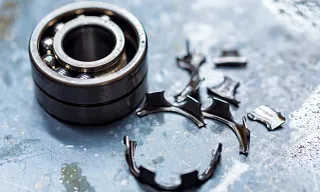
Choosing the right material for ball bearings is not always easy so here are some advantages and disadvantages of the core ball bearing materials to help with your decision.
Metal ball bearings
Metal ball bearings are used in most classic mechanical engineering applications. They are number one in terms of global sales volumes and are suitable for a wide range of different mechanical engineering applications. However, they always reach the limits of their application when, in addition to load bearing and speed, further requirements are placed on the bearing. This applies to various sectors such as the food industry or medical technology. Here, specifications such as suitability for contact with food or use in cleanrooms are crucial. System manufacturers often require food certification in accordance with EU standard 10/2011 or FDA (American authority: Food and Drug Administration).
Plastic ball bearings
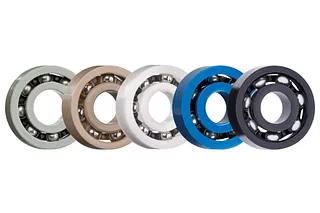
The advantage of plastic lies in the variety of materials. This means that different base polymers can be selected for a wide variety of applications, which are suited to the application in terms of their specifications.
In recent years, base polymers such as POM, PP, PEEK and other plastics have become established. Ball bearings made of plastic can be suitable for the following industries and applications:
- Food industry (advantage of food contact)
- Medical technology (FDA conformity)
- Chemical industry (Chemical resistance)
- Textile industry (No dust and dirt adhesion)
- Vacuum / high temperatures (No destruction of the lubricant)
- Special applications such as MRI or metal detectors (Metal-free)
Ceramic ball bearings
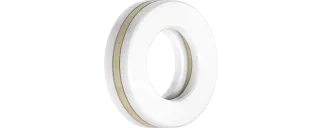
For plastics and ceramics, aqueous media act like lubricants. With a suitable design, the coefficient of friction can be stabilised at a low level of around 0.1 or even lower. Wear is very low, so that a long service life is generally achieved. In terms of load-bearing capacity and achievable speed, both plastics and ceramics have disadvantages compared to metals. Regardless of the variety of metal materials, metals have a good combination of hardness and flexibility. Plastic, on the other hand, is significantly softer and can deform more quickly (especially at high temperatures). Although ceramics are very hard, they also have the lowest flexibility and can break quickly under impact loads. In addition, the heat dissipation of ceramics and plastic is lower than that of metal. They are therefore also limited in terms of the maximum realisable speed.
Metal, plastic or ceramic ball bearings?
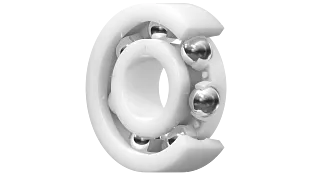
The materials for ball bearing balls are versatile and can be adapted to the application environment. Ball bearings made of metal, plastic or ceramic use different balls. Here you can see an overview of the materials for ball bearing balls and the special material properties.
Additional resources and technical information


Contact us
Contact details

Alan Hicks07467 956571Contact us
Opening hours
Office hours
Monday to Friday from 8 am - 8 pm.
Live chat:
24h