Change Language :
Ball bearings
Ball bearings are mechanical components used to reduce friction and maintain a smooth, rotational movement in equipment and machinery. Ball bearings comes in a range of different types, sizes and materials, including metal, plastic and ceramic. They are designed to accommodate varying loads, speeds and operating conditions and be able to cope with different environmental elements.
When choosing the right ball bearing, it is crucial to understand how they work, understand the differences between bearing types as well as the advantages of each material. This helps when selecting the most suitable ball bearing for each application.
How are ball bearings made?
Ball bearings are manufactured by forming metal into both inner and outer rings or 'races' as well as creating precision steel balls. All components are heat-treated which improves hardness and wear resistance. These are then ground and polished, achieving a smooth surface. The balls are assembled between the rings/ races and held in place by a cage. Each ball bearing needs to be cleaned, inspected and lubricated where needed, to ensure reliable performance.
How do plastic ball bearings compare to metal?
| Feature | Metal ball bearing | Plastic ball bearing |
|---|---|---|
| Lubrication | Normally requires lubrication | Can operate without lubrication |
| Cost | Typically more expensive than plastic | Usually cheaper than metal |
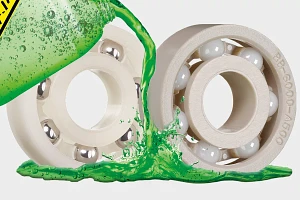
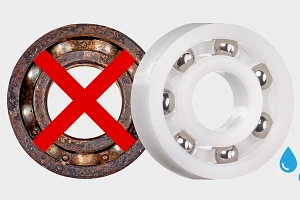
| Corrosion resistance | Depends on the metal but some metals are prone to rust when subjected to certain environmental elements | Depending on the material, some plastics offer excellent corrosion resistance |
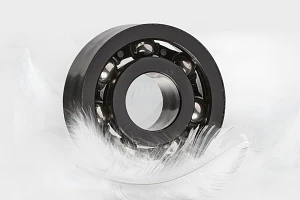
| Weight | Generally heavier | Generally lighter |
| Temperature | Dependent on numerous aspects such as the material, lubrication used | Dependent on the material, some plastics are designed to allow for particularly high temperatures. |
| Noise | In some cases, they can be noisier than plastic ball bearings in operation | Tend to be a quieter option to metal in most applications |
| Suitable applications | High loads, higher stiffness, high speed and high temperature | Often lower weight, although some materials are highly suited for high loads, lubrication-free operation, corrosion resistant and quieter applications |
What advantages do our ball bearings offer?

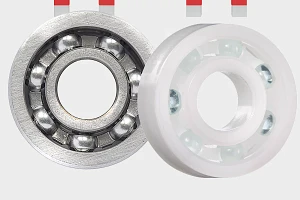

Which is the right ball bearing for your application?
We want to help you pick the best ball bearing for your application.
With our ball bearing online configurator, you can add your required parameters, pick the material and any possible environmental elements and receive a price, availability and technical data.
Where are ball bearings used? And what types are there?
There are various designs of ball bearings, whereby the dimensions and technical composition of the components depend on the specifications of the industrial application. The most commonly used types are shown below.
Radial deep groove ball bearing according to DIN 625: This type of ball bearing absorbs radial forces and is used wherever components rotate. In the automotive industry, for example, radial deep groove ball bearings can be found in the chassis, where the ball bearings are used to support and guide the axles. A radial force is always applied when the axle performs a rotary movement.
Angular contact ball bearing according to DIN 628: This bearing is designed to absorb both radial and axial forces in one direction. Angular contact ball bearings make higher speeds possible and reduce friction for a wide range of loads. Angular contact ball bearings are used in the bicycle industry, the automotive sector or in lead screws on machine tools.
Self-aligning ball bearing according to DIN 630: This type of ball bearing is generally used in applications with long shafts. This is due to assembly problems caused by holes in the housing. The axial force plays a role in self-aligning bearings. This must be kept low, as the grooves in the outer ring have limited contact surfaces for rolling elements. It is used in general mechanical engineering.
Thrust bearing according to DIN 711: Also referred to as an axial deep groove ball bearing, this type is designed to support axial loads. They are available in a single-row or double-row design and are already used in numerous applications in medical technology or the packaging industry.
Ball bearing types


FAQ: Frequently asked questions
Ball bearings belong to the family of rolling bearings. Moving between an inner ring and an outer ring, rolling bodies reduce rotational friction and absorb radial and axial loads. Because the balls roll, they have a much smaller coefficient of friction than two flat surfaces that slide against each other. Due to the smaller contact surface between balls and rings, the ball bearings tend to have a lower load capacity for their size than other kinds of rolling bearings.
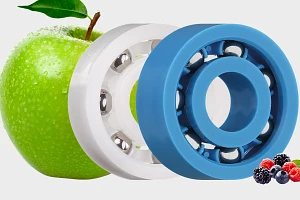
Ball bearings are used to reduce rotational friction in many applications and industries, such as labelling machines, food and packaging, conveyors and high speed applications.
xiros® plastic ball bearings are lubrication and maintenance-free. They are lightweight, corrosion resistant and have a high media resistance.
Ball bearings come in a huge range of sizes as standard and can be customised to be manufactured to your requirements.
Ball bearings reduce friction simply by replacing high-resistance sliding friction with low-resistance rolling friction this reduces the frictional torque.
Not all ball bearings require lubrication, the majority of metal types use lubrication however many plastic variants may not require it. igus ball bearings do not need lubrication as the material is a self lubricating polymer.
Deep groove ball bearings in particular are used as a support to axial and radial loads.
Radial loads are the loads perpendicular to the shaft while the axial loads are parallel. The ball bearings rotate while reducing friction.
Yes of course, it is bearing dependent as far as capacity but ball bearings do take axial or thrust loads.
It depends on the material and the application. We have an online tool to help understand and calculate the service life of our ball bearings.
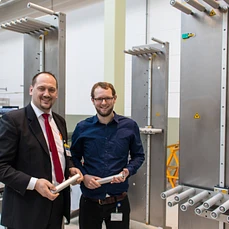
The smooth running of the ball bearings in the guide rollers is very important for us. In the past, we used metal bearings here. However, these were not light enough, sometimes making the roller stop and the label tape would slip over it.
Sören Meissner
Design engineer for labelling technology at Krones AG
Additional resources and technical information




Contact us
Contact details

Alan Hicks07467 956571Contact us
Opening hours
Office hours
Monday to Friday from 8 am - 8 pm.
Live chat:
24h