Change Language :
Predictive Maintenance Solutions for Energy Supply Systems
Eliminate unplanned downtimes and extend service life of igus products
Predictive maintenance solutions start with intelligent networking. At igus®, our i.Cee predictive maintenance software - paired with predictive maintenance sensors on energy chains, bearings, and linear guides, transforms stock products into smart products. This upgrade helps you predict service life and schedule maintenance at the perfect time.

The i.Cee predictive maintenance hardware


You determine the access of data transfers
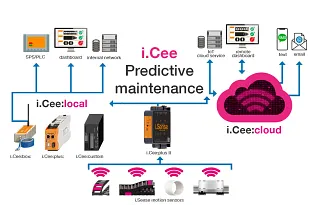
i.Cee:local
Your data never leaves your corporate network, since the i.Cee software communicates only within the networks you want it to. The options range from an e-chain® within a single machine to a machine park and your own output interface.
i.Cee:cloud
This online solution has two options. In the first, your data is transferred directly to the cloud, where it is made available in a protected area that can be accessed with a browser dashboard. In the second, the data go to an intermediate location on the i. Cee.net: a so-called data concentrator allowing you to stop or adjust data exchange in the cloud.
Applications with smart plastics
Predictive maintenance solutions that utilise e-chain®, chainflex® cables and bearings.


Frequently asked questions regarding predictive maintenance solutions
Predictive maintenance is generally understood to mean the early anticipation and avoidance of an error in machinery or components thanks to data on their condition. This is possible with data-based methods that analyse the condition of your machines and help predict malfunctions, faults and also the time when maintenance work is required.
Predictive maintenance solutions by igus® is powered by the i.Cee system, which uses sensors and software to monitor the condition of components like energy chains and bearings. These sensors detect wear, movement patterns, and other key metrics, allowing the i.Cee software to calculate the optimal service time and maximum service life. This proactive approach helps prevent unexpected failures and costly downtime.
Industry 4.0 promises greater efficiency in production through networked machines, insights due to data analyses and better machine availability. In this context, predictive maintenance, i.e. a forward-looking maintenance process based on the evaluation of process and machine data, is a crucial component.
Unplanned downtime of production equipment costs money and cuts your profits significantly in the long run. What is certain is that machine and system failures pose a serious threat to the industrial sector. Predictive maintenance is intended to lead to cost savings compared to routine, interval- or time-based preventive maintenance as work is only carried out when necessary.
First of all, various sensors are needed to record functionally relevant data on the machines, such as speed, temperature, noise, bearing vibrations or power consumption. Next, a combination of real-time analysis technology and a database is required to interpret and meaningfully analyse the sensor data. If all this is successful, it will be possible to rectify the machine problem before it actually arises.
Implementation involves installing i.Cee-compatible sensors on your igus® energy chains and connecting them to the i.Cee software via modules like i.Cee:plus II or i.Cee:box. You can choose between local data processing (i.Cee:local) or cloud-based monitoring (i.Cee:cloud), depending on your infrastructure. The system is modular and can be tailored to your specific setup.
- Preventive maintenance is scheduled at regular intervals, regardless of actual wear or usage.
- Predictive maintenance, on the other hand, uses real-time data to determine when maintenance is truly needed, based on actual component condition. This reduces unnecessary servicing and extends product life.
No. Predictive maintenance is not only interesting for the manufacturing industry or associated MRO areas (Maintenance, Repair & Operations), but also for all mobility services - whether in the air, in vehicles or on rails.
It is usually worthwhile for companies that frequently use the same type of machine or do not want to use predictive maintenance for their own production, but for the machines they sell.
In manufacturing, predictive maintenance ensures that machines and components like energy chains, bearings, and cables are serviced only, when necessary, based on real-time data. This is especially valuable in high-demand environments like automotive production, where downtime can be extremely costly.
- Avoiding unplanned system downtime
- Reduce maintenance and servicing costs
- Maximise the service life of igus® products
- Improve system efficiency and safety
- Cost savings through reduced downtime and maintenance
- Extended product life
- Improved planning and resource allocation
- Integration with Industry 4.0 and IIoT systems
- Customisable solutions for various industries and applications
- Initial setup and integration with existing systems
- Data management and security (especially with cloud solutions)
- Training staff to interpret and act on predictive insights
- Customisation for complex or legacy systems
Key data includes:
- Movement patterns
- Wear measurements (e.g., clearance in chain links)
- Temperature, vibration, and force metrics
- Usage frequency and load conditions. This data is collected via smart sensors and processed by the i.Cee software to generate actionable insights.
No, wear monitoring systems must be used in conjunction with a new energy chain system. This ensures that the system starts with a clear baseline for wear and performance data, which is essential for accurate predictive maintenance. Retrofitting to older chains may not provide reliable insights due to unknown or inconsistent wear history.
- Higher system availability thanks to less downtime
- Maximisation of the service life of systems and machines
- Optimised deployment of maintenance technicians
- Plannable maintenance times
- Higher machine performance and productivity
Of course, there are the one-time investment costs for sensor hardware and software for data analysis and evaluation. In addition, every new method initially requires change and training efforts. However, these can be reduced to a minimum with the ready-to-install smart plastics solutions from igus i.Cee.
Between 50 and 70% less unplanned downtime should be possible, as well as savings of 20 to 40% in maintenance costs, depending on which study by the two renowned consulting firms McKinsey or Accenture you prefer to trust. In addition, Roland Berger claims to have discovered that with predictive maintenance, only 15 per cent of the time is spent on maintenance. With traditional reactive maintenance, this figure is 40 per cent of the time.
According to the authors of a survey conducted by another technology consultancy, Bearing Point, among experts in maintenance, production, logistics and IT, over 80% of users expect predictive maintenance to increase system availability, i.e. OEE (Overall Equipment Effectiveness).
The collection and analysis of machine data is essential to this type of intelligent maintenance work. With the help of this data, it is possible to calculate the optimum time for maintenance in order to avoid malfunctions. Machine data is usually collected via sensors attached to the machine or system component, often aptly called predictive maintenance sensors. In igus energy chains, this job is performed by i.Sense condition monitoring sensors from smart plastics. This intelligent sensor technology continuously records the various operating states of the energy supply.
The prerequisite for the most accurate possible indication of fault-free running time is that information on usage is as accurate as possible. This includes information on the place of use with weather conditions and temperatures, distances covered, number of cycles, etc. Thanks to the knowledge acquired in the igus test laboratory and the current condition data, igus is able to predict the service life data precisely. A necessary replacement of a component is then indicated in good time and enables planned and resource-conserving maintenance.
A prerequisite for predictive maintenance is that the machines are networked, i.e. all machines provide their data for storage and analysis in a database. This is ensured by an OPC UA protocol.
However, with igus i.Cee solutions for predictive maintenance, no additional systems or hardware are required. All necessary data is provided by the associated i.Sense sensors, and the special AI algorithms are implemented in the i.Cee module. The associated i.Cee dashboard can be accessed from any standard PC.
Predictive maintenance is primarily used in industries in which the failure of systems, machines or components means considerable consequential damage and downtime costs:
- Aviation: Airlines use sensors in their aircraft to replace wear-resistant parts such as turbines or pumps in good time and avoid downtime on the ground.
- Automotive: Automotive companies operate some of the largest robot parks in the world, produce just in time and have tightly integrated supply chains. Any disruption to production, e.g. unplanned downtime, leads to disruption to the entire supply chain.
- Wind turbines: Vibration analyses can now almost completely prevent wind turbine failures.
- Ports: Crane breakdowns mean long waiting times for ships and less throughput for ports.
Predictive maintenance solutions from igus smart plastics are already in use in most of these industries.
Find out more about potential areas of applicationIn its DIN EN 13306 Terms and Definitions of Maintenance, the German Institute for Standardisation (DIN) defines a maintenance strategy as a procedure for achieving maintenance objectives, such as maintaining a specified condition or extending the life expectancy of a machine. A distinction is usually made between the following three different approaches:
- Reactive maintenance strategy / Damage-dependent maintenance strategy
- Preventive maintenance strategy
- Predictive maintenance strategy
With reactive maintenance, damage to machines is only repaired and production parts replaced when an acute malfunction occurs. This means that companies must react quickly in the event of damage in order to continue production as quickly as possible and avoid high downtimes and costs. This strategy is mostly used for machines that do not need to be repaired often or that can be repaired or replaced inexpensively.
Preventive maintenance is a maintenance strategy in which measures are carried out at specific intervals. These can be time- or quantity-dependent. This means that you do not wait until systems or machine parts break down, but carry out systematic preventive inspections and maintenance measures. The actual degree of wear and tear on the machines and systems is irrelevant. In predictive maintenance, on the other hand, process and machine data is collected during operation via sensors and interfaces, stored and then analysed.
In practice, predictive maintenance often makes sense for machines where a breakdown would result in high sales losses or consequential damage. Modern machines are often already equipped with the necessary measurement sensors. Older models can be retrofitted with them. These can be for example:
- Vibration measurements on systems, provide information about imbalances, incipient bearing damage, etc.
- Temperature measurements, provide information about bearing damage or cooling problems
- Measurements of the current consumption of pumps, motors, etc., provide information on sluggish drives, couplings, etc.
- Measurements of the transmission properties of data cables provide information about the remaining service life
- Force or load cell sensors help to determine the current capacity utilisation
In the field of dynamic energy management applications, igus already has a broad product portfolio available with its smart plastics.
Recommended for you


Contact us
Contact details

Opening hours
Office hours
Monday to Friday from 8 am - 8 pm.
Live chat:
24h